
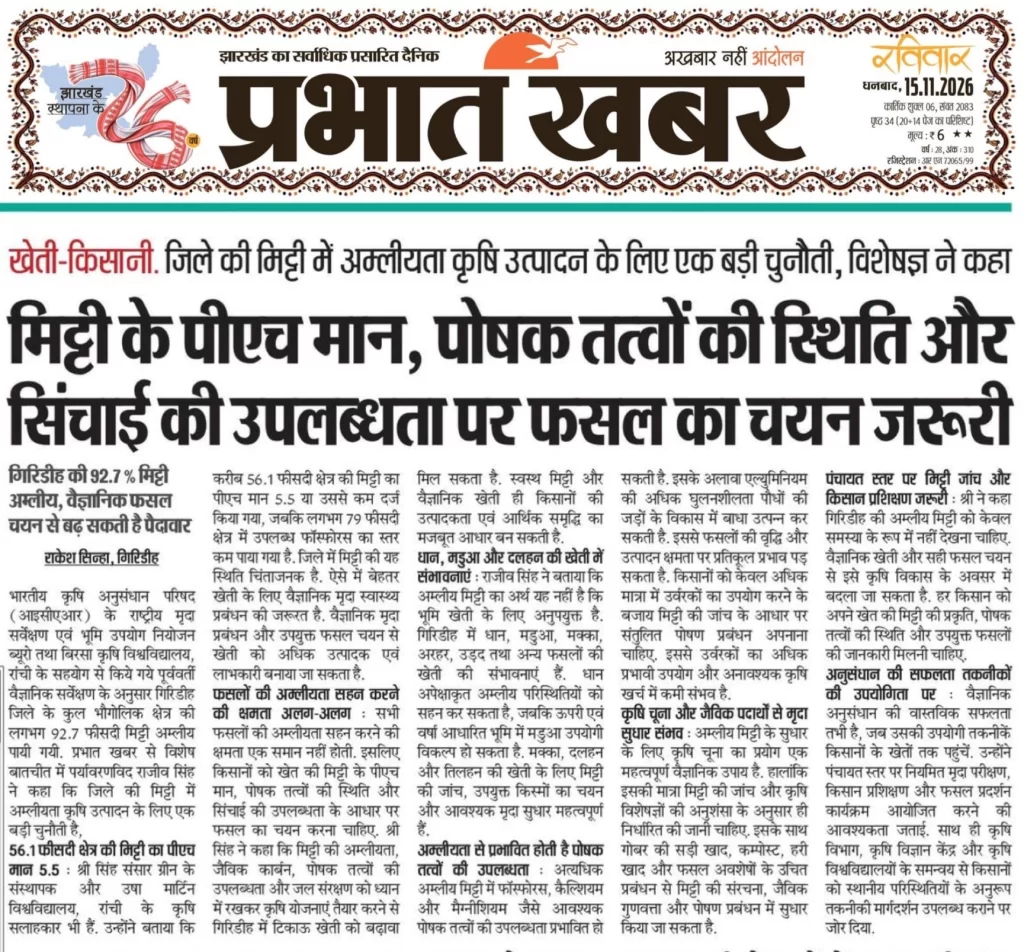
Giridih Soil Health Crisis: Prabhat Khabar Highlights Rajeev Singh’s Insights on Sustainable Agriculture in Jharkhand
Prabhat Khabar reports that 92.7% of surveyed soil in Giridih is acidic, highlighting the urgent need for scientific soil management, natural farming, and sustainable agricultural solutions.
Giridih, Jharkhand | November 15, 2026
Soil health is emerging as a major challenge to Jharkhand’s agricultural future. A significant report published in the November 15, 2026 edition of Prabhat Khabar has highlighted widespread soil acidity, nutrient deficiencies, and the importance of scientific crop selection in Giridih district.
The report prominently features the insights of Rajeev Singh, environmentalist, agripreneur, and Founder & Chairman of Sansar Green, emphasizing the importance of soil restoration, sustainable farming, and science-based agricultural practices.
Alarming Soil Health Findings in Giridih
According to the survey findings reported by Prabhat Khabar:
- 92.7% of the surveyed soil area was found to be acidic.
- 56.1% recorded a soil pH of 5.5 or below.
- Approximately 79% showed low levels of available phosphorus.
The survey, conducted with the involvement of ICAR’s National Bureau of Soil Survey and Land Use Planning and Birsa Agricultural University, highlights the need for scientific soil management and appropriate crop planning.
These findings raise concerns about soil fertility, nutrient availability, agricultural productivity, and the long-term sustainability of farming in Jharkhand.
Rajeev Singh Emphasizes Scientific Crop Selection
The report highlights Rajeev Singh’s perspective that acidic soil does not necessarily mean unsuitable agricultural land.
With appropriate crop selection, balanced nutrient management, scientific soil testing, and suitable irrigation practices, productive agriculture remains possible under many acidic soil conditions.
Crops such as paddy, maize, pigeon pea, and black gram may offer opportunities depending on local soil characteristics and farming conditions.
Sansar Green’s Commitment to Soil Restoration
Under the leadership of Founder & Chairman Rajeev Singh, Sansar Green continues to promote natural farming, organic agriculture, microbial-based agricultural innovations, and sustainable soil management.
The organization believes that improving soil health is essential for strengthening farmers’ livelihoods, protecting biodiversity, and building a resilient agricultural economy.
Our key areas of focus include:
- Natural and organic farming
- Microbial-based agricultural innovations
- Soil fertility improvement and regeneration
- Scientific soil testing and nutrient management
- Environmentally responsible agricultural practices
- Farmer awareness, training, and empowerment
Sansar Green emphasizes the integration of scientific agricultural research with practical, affordable, and locally suitable solutions.
Towards a Sustainable Agricultural Future for Jharkhand
Addressing Jharkhand’s soil health challenges requires collaboration among farmers, agricultural universities, research institutions, government agencies, and agricultural enterprises.
Village-level soil testing, appropriate soil amendments, farmer training, and sustainable crop management can contribute to long-term agricultural resilience.
Sansar Green appreciates Rakesh Ji and the editorial team of Prabhat Khabar for highlighting this critical issue and featuring Rajeev Singh’s insights on sustainable agriculture.
The organization remains committed to advancing agricultural practices that restore soil productivity, conserve natural resources, and support farmers’ prosperity.
🌱 Healthy Soil. Prosperous Farmers. Sustainable Agriculture. A Greener Jharkhand.