
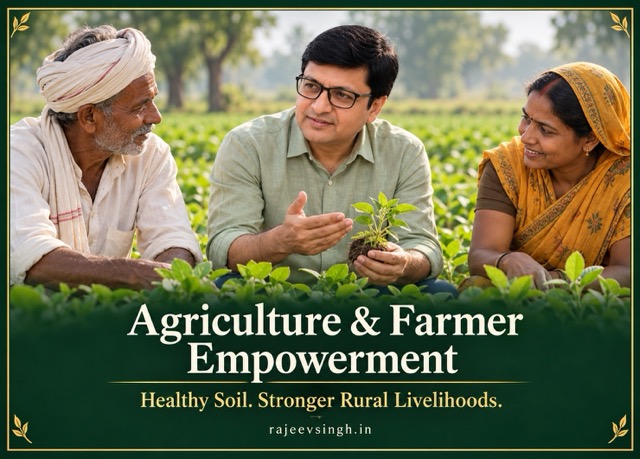
Agriculture & Farmer Empowerment
Healthy Soil | Informed Farmers | Stronger Rural Livelihoods.
Agriculture connects the health of our land with the well-being of our communities. Supporting farmers means helping them access practical knowledge, suitable inputs, useful technology and opportunities to earn better value from their work.
For Rajeev Singh, agripreneur, sustainability leader and IIM alumnus, farmer empowerment is central to building a greener and more resilient India. His work through Sansar Green connects sustainable agriculture with soil care, farmer education and rural entrepreneurship. The focus is on making knowledge accessible and helping farmers apply it under their own field conditions.
The guiding vision is “मिट्टी से मंडी तक” — from soil to market: an approach that considers the farmer’s entire journey, from preparing the land to reaching the buyer.
Building Agriculture Around Soil Health
Healthy soil is the foundation of productive farming. Its condition influences root growth, nutrient availability, water retention and the long-term performance of crops.
Rajeev Singh’s approach places soil care at the centre of agricultural decision-making. This includes encouraging soil assessment, improving organic matter, understanding beneficial microorganisms and choosing inputs according to crop and field requirements.
Through Sansar Green’s work in organic and biological agricultural inputs, the emphasis is on helping farmers understand what their soil needs and how different practices can support it. Soil improvement requires observation, suitable interventions and consistent care across seasons.
Making Sustainable Farming Practical
Farmers need approaches that fit their land, available resources, labour and market conditions. The transition towards organic or natural farming must therefore be supported by practical guidance and realistic planning.
Key areas of focus include:
- Composting, organic matter management and the productive use of farm residues.
- Appropriate use of biofertilisers and microbial formulations.
- Crop rotation, crop diversity and locally suitable cultivation practices.
- Responsible pest and disease management.
- Efficient irrigation and soil-moisture conservation.
- Field records that help farmers assess costs, crop performance and results.
The aim is to help farmers make informed choices. Demonstrations and field observations can support decisions about which practices to adopt, adapt or expand.
Empowerment Through Knowledge
Access to inputs is only one part of agricultural development. Farmers also need to understand when an input is useful, how to apply it and how to recognise whether it is working.
Practical learning is therefore an essential part of Rajeev Singh’s work. Farmer interactions, training sessions and educational content create opportunities to discuss everyday challenges in accessible language.
These conversations cover soil preparation, crop nutrition, plant care, composting, water management and sustainable cultivation. They also create space for farmers to share their own experience. Local knowledge helps ensure that advice remains relevant to the conditions in which it will be used.
An empowered farmer can ask better questions, compare options and make decisions with greater confidence.
Connecting Research with the Field
Agricultural research becomes valuable to farmers when it addresses a practical need and can be applied under local conditions.
Through the research and training focus of SIART — the Sansar Institute of Agricultural Research & Training — Rajeev Singh seeks to strengthen connections between agricultural knowledge, field learning and farmer needs.
This approach brings attention to soil health, beneficial microorganisms, agricultural inputs and sustainable crop management. It also creates opportunities for dialogue among researchers, students, agricultural professionals and farming communities.
Field demonstrations, collaborative trials and farmer feedback can help assess whether an approach is suitable before wider adoption. The goal is to make the journey from research to practical use more responsive to the farmer.
From Soil to Market: मिट्टी से मंडी तक
A farmer’s work continues beyond cultivation. Harvesting, sorting, handling, packaging and selling all influence the value that produce can realise.
The soil-to-market vision brings these stages into a connected approach:
- Understand the soil and local growing conditions.
- Select suitable crops, planting material and inputs.
- Support cultivation through knowledge and timely guidance.
- Improve harvesting and post-harvest handling.
- Explore appropriate market channels and buyer relationships.
This perspective encourages farmers to consider production and marketing together. Understanding quality requirements, seasonal demand and handling needs can support better planning before the crop reaches harvest.
Through the wider Sansar Green ecosystem, the aim is to connect agricultural inputs, learning and market opportunities more closely with farmers’ needs.
Supporting Women and Rural Youth
Farmer empowerment must include the people whose contributions sustain rural agriculture every day.
Women play important roles in cultivation, seed care, household gardens, livestock support and post-harvest work. Meaningful participation in training and decision-making helps ensure that agricultural initiatives reflect their knowledge and priorities.
Rural youth also need opportunities to build livelihoods around agriculture. Nursery development, compost production, agricultural services, produce handling and local marketing are potential areas for enterprise when supported by skills, demand assessment and sound planning.
Rajeev Singh’s focus on agri-entrepreneurship encourages people to identify local problems and develop useful, practical solutions. Training, mentorship and institutional connections can help turn these ideas into carefully planned activities.
Linking Agriculture with Water and Ecology
Farmer well-being is closely connected to the wider landscape. Water availability, vegetation, biodiversity and soil condition all influence agricultural resilience.
Rajeev Singh’s agricultural work sits alongside his interests in water-body restoration, plantation and ecological recovery. Together, these themes support a broader understanding of rural development: productive farms depend on functioning ecosystems.
Water conservation, appropriate tree planting and care for local natural resources can complement farm-level improvements. Community participation is essential to sustaining these efforts over time.
Working Together for Farmer Empowerment
Lasting progress requires cooperation among farmers, researchers, institutions, businesses and community organisations.
Rajeev Singh welcomes opportunities to collaborate on practical farmer training, soil-health awareness, field demonstrations, agricultural research, rural entrepreneurship and responsible market connections.
Universities, farmer producer organisations, self-help groups, NGOs and CSR teams can contribute knowledge, local relationships and resources to well-defined initiatives. Each collaboration should begin with a clear understanding of community needs, suitable activities and achievable objectives.
The purpose is to help farmers build the knowledge, confidence and connections needed to shape their own future.
Let’s Build Stronger Farming Communities
Connect with Rajeev Singh to explore farmer training, sustainable agriculture initiatives, research partnerships and rural enterprise development.
Together, we can work towards healthier soil, more informed farming decisions and stronger rural livelihoods.
Enquire About Collaboration | Explore Research & Training