
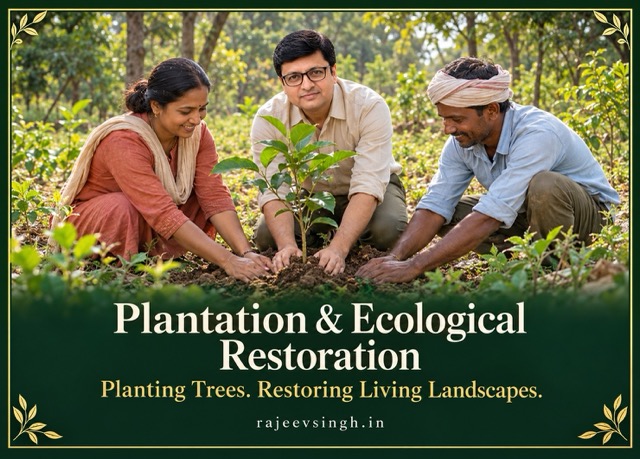
Plantation & Ecological Restoration
Planting Trees | Restoring Living Landscapes
A tree planted today carries a responsibility that continues for years. It needs suitable soil, space to grow, protection and consistent care. A restored landscape requires even more: an understanding of water, native vegetation, biodiversity and the people who depend on the land.
For Rajeev Singh, plantation and ecological restoration are closely connected with community well-being. His work brings together environmental awareness, practical plantation planning, soil care and public participation, with the aim of helping degraded landscapes recover and supporting greener places to live and work.
Through Harit Sansar and associated initiatives, this vision encourages individuals, institutions, businesses and communities to take an active role in planting, protecting and nurturing trees.
A Purpose for Every Plantation
Successful plantation begins with understanding the site and deciding what the planting should achieve.
A village fruit plantation, an institutional green space, a forest recovery initiative and a commercial orchard each require a different approach. Species selection, spacing, soil preparation, water availability and maintenance must reflect those differences.
Rajeev Singh’s approach connects plantation planning with the intended purpose of the land. Priorities include supporting biodiversity, improving vegetation cover, creating shade, protecting soil and, where appropriate, developing productive planting systems that contribute to livelihoods.
The guiding principle is simple: choose suitable trees for suitable locations, and plan for their care from the beginning.
Restoring the Foundations of Growth
Degraded land often needs attention before planting can succeed. Compacted soil, erosion, poor drainage, low organic matter or limited access to water can restrict root development and plant establishment.
Ecological restoration begins with assessing these conditions and identifying appropriate measures. Depending on the site, this may involve improving soil structure, managing runoff, adding suitable organic matter, protecting existing vegetation or preparing the root zone for planting.
Rajeev Singh’s interest in soil health and beneficial microorganisms connects this work with his broader agricultural mission. Biological interventions, where appropriate and supported by assessment, can form part of a wider restoration approach alongside physical soil improvement and long-term care.
The aim is to create conditions in which plants can establish and the surrounding ecosystem can begin to recover.
Native Vegetation and Biodiversity
Restoration planning should respect the character of the local landscape.
Locally appropriate native trees, shrubs and groundcover can support habitat recovery and strengthen connections with surrounding vegetation. Existing natural regeneration also deserves attention: protecting young plants already growing on a site may be an important part of its recovery.
Planting decisions should consider local ecology, available space, water conditions and the needs of nearby communities. Diverse planting may be appropriate where it reflects the ecosystem being restored.
Ecological restoration also recognises that every open space does not need trees. Grasslands, wetlands and other naturally open habitats require approaches suited to their own ecological character.
Harit Sansar: Participation That Continues Beyond Planting
Through Harit Sansar, Rajeev Singh encourages people to become active participants in environmental care.
Community plantation programmes can create a shared connection with the land, particularly when local people help choose locations, understand the purpose of planting and take part in ongoing care.
Schools, colleges, neighbourhood groups and village communities can contribute through planting, watering, mulching, protecting young trees and observing their growth. These activities also create practical opportunities to learn about soil, water and biodiversity.
A meaningful plantation initiative gives participants a role beyond the planting day. Clear responsibilities and regular follow-up help turn initial enthusiasm into sustained stewardship.
CSR and Institutional Plantation
Businesses and institutions can support environmental improvement through carefully planned plantation and restoration initiatives.
For CSR teams, educational campuses and other organisations, the starting point should be a clear assessment of the site, its needs and the resources available for maintenance. Project design should connect environmental objectives with practical responsibilities.
Areas for collaboration include:
- Community plantation with arrangements for continued care.
- Native planting and habitat improvement on suitable land.
- Campus greening and environmental learning spaces.
- Restoration of degraded sites following appropriate assessment.
- Tree-care training and community awareness.
- Monitoring plant establishment and maintenance needs.
Rajeev Singh welcomes collaborations that combine thoughtful planning, community involvement and a realistic commitment to follow-up.
Commercial Plantation with Long-Term Planning
Commercial plantation has its own objectives and management requirements. Fruit orchards, agroforestry systems and other productive plantations need to be planned around site suitability, crop requirements, water resources and market considerations.
Species and planting-material selection are only the beginning. Spacing, irrigation, soil management, pruning, plant protection and harvesting arrangements influence how a plantation develops over time.
Rajeev Singh’s wider work in agriculture and farmer empowerment connects productive planting with practical learning and rural enterprise. The emphasis is on informed decisions and consistent management, with ecological considerations included in the planning process.
Commercial plantation and ecological restoration serve different purposes. Each should be designed and evaluated according to its own objectives.
Caring for Trees After Planting
Plantation success depends heavily on what happens after saplings enter the ground.
Young plants may require watering during dry periods, protection from grazing, appropriate mulching and timely attention to damage or stress. Maintenance needs change with the species, season and site.
A practical care plan identifies who will look after the plants, how often the site will be checked and what action will be taken when problems arise. Where replacement planting is needed, understanding why the original plants failed helps improve the next attempt.
This approach places continuing care at the centre of plantation work.
Observing Recovery and Learning from the Field
Monitoring helps communities and project teams understand how a site is responding.
Useful observations may include plant survival, growth, soil cover, signs of erosion, natural regeneration and the condition of protective measures. Photographs and simple field records can help track change and guide maintenance.
For ecological restoration, progress should be assessed against the needs of the site and the objectives established at the beginning. Recovery takes time, and management may need to adapt as conditions change.
Rajeev Singh’s vision supports a culture of learning from the field, where observations inform decisions and experience improves future work.
Partnerships for Greener Landscapes
Restoring land brings together many kinds of knowledge. Communities understand local conditions, researchers contribute technical insight, institutions provide learning opportunities, and businesses can support resources and implementation.
Rajeev Singh welcomes dialogue with government bodies, universities, CSR teams, NGOs, farmer organisations and community groups interested in plantation and ecological restoration.
Potential collaborations can focus on site assessment, native planting, community participation, soil improvement, practical training and long-term maintenance.
The shared purpose is to help trees establish, strengthen the conditions for ecological recovery and build a lasting connection between people and the landscapes they care for.
Be Part of the Work
Whether you are planning a community plantation, improving an institutional landscape or exploring the restoration of suitable degraded land, begin with a clear purpose and a commitment to continued care.
Connect with Rajeev Singh to discuss plantation initiatives, restoration partnerships and opportunities to participate through Harit Sansar.
Partner for Plantation | Explore Restoration Collaboration | Participate with Harit Sansar