
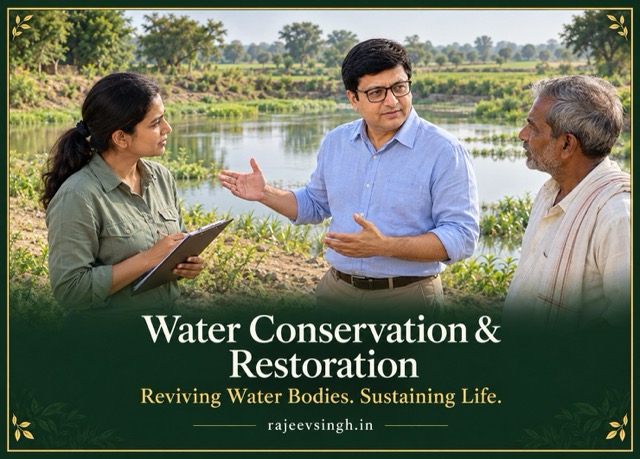
Water Conservation & Restoration
Reviving Water Bodies | Sustaining Life.
Water connects the health of our environment with the strength of our communities. Ponds, lakes and wetlands support agriculture, provide habitats and form an important part of local life. Their protection requires an understanding of the land around them, the water flowing into them and the people who depend on them.
For Rajeev Singh, water conservation is closely connected with sustainable agriculture, ecological restoration and rural development. His vision brings these priorities together through practical planning, environmental awareness and community participation.
Through his association with Erwon Energy Pvt. Ltd. and related environmental initiatives, he advocates an approach that considers both the recovery of water bodies and their continued care.
Understanding Each Water Body
Every water body has its own history, seasonal behaviour and relationship with the surrounding landscape. A village pond, an urban lake and a wetland may face very different pressures.
Restoration begins with understanding those conditions. Relevant questions include where water enters and leaves, how the surrounding land is used, whether pollution sources are present and how the water body changes between seasons.
Local experience is valuable in this process. Community members can often explain changes in water levels, past uses, recurring problems and earlier maintenance efforts. Combined with appropriate technical assessment, this knowledge helps establish realistic restoration priorities.
Addressing the Causes of Degradation
A water body’s condition is shaped by what happens across its catchment—the surrounding area from which water drains into it.
Wastewater, solid waste, soil erosion and polluted runoff can undermine restoration work if their sources remain unaddressed. Protecting a pond or lake therefore requires attention to both the water and its surroundings.
Rajeev Singh’s broader environmental approach encourages this connection between land and water. Soil protection, suitable vegetation, responsible waste management and community awareness can complement work within the water body itself.
The objective is to identify the causes of deterioration and develop measures suited to the site.
Planning Restoration with Ecological Care
Restoration may involve several activities, depending on the problems identified through assessment. These can include managing pollution sources, improving water circulation where appropriate, stabilising eroding banks or restoring suitable shoreline vegetation.
Sediment removal requires particular care. Decisions about whether to desilt, how much material to remove and how to handle it should reflect the water body’s ecology, sediment condition and intended function.
Similarly, biological treatment approaches need to be selected for the conditions present and evaluated through monitoring. No single intervention can address every water-quality problem.
A thoughtful plan brings these decisions together, defines responsibilities and allows for follow-up as the site responds.
Protecting Wetlands and Aquatic Habitats
Wetlands and vegetated shorelines are living parts of the landscape. Their plants, soils and seasonal water patterns support a variety of ecological functions.
Restoration should respect these characteristics. Native vegetation, where suitable, can help protect banks and provide habitat. Existing plants and natural shallow-water areas should be assessed before any clearing or reshaping takes place.
The aim is to support a functioning ecosystem that reflects the site’s natural conditions. An attractive appearance alone does not show whether a water body is recovering.
Connecting Water Conservation with Agriculture
Reliable access to water is a major concern for farming communities. Rainfall variability, dry periods and competing demands make careful water management increasingly important.
Rajeev Singh connects water conservation with his work in soil health and farmer empowerment. Farm-level practices such as protecting soil cover, managing irrigation carefully and reducing unnecessary water loss can complement wider landscape efforts.
Where local geology and hydrology are suitable, protecting water bodies and managing runoff may also support groundwater recharge. Such benefits need to be assessed for each location.
This approach encourages farmers and communities to consider soil, crops, vegetation and water as connected parts of the same landscape.
Community Participation and Shared Responsibility
Long-term care depends on the people who live around and use a water body.
Community participation helps clarify local needs and establish responsibilities for maintenance. Farmers, residents, women’s groups, young people and local institutions can contribute observations, practical knowledge and continued attention.
Participation may include:
- Identifying recurring pollution and waste problems.
- Supporting awareness about responsible water use.
- Caring for appropriate shoreline vegetation.
- Reporting changes in water levels or visible water condition.
- Helping maintain agreed protection measures.
- Encouraging cooperation among different water users.
Clear responsibilities and regular communication help sustain this involvement beyond an initial restoration activity.
Partnerships for Water Restoration
Water conservation benefits from cooperation among communities, technical specialists, public institutions and businesses.
Rajeev Singh welcomes opportunities to explore partnerships with government bodies, universities, CSR teams, NGOs and local organisations. Potential areas include site assessment, restoration planning, environmental education, community engagement and monitoring.
For CSR and institutional projects, a useful starting point is a clearly defined need, an achievable scope and a realistic provision for continued care. Project planning should consider who will manage the site after the initial work is completed.
Partnerships are strongest when technical knowledge and local priorities inform each other.
Monitoring Progress Over Time
Water-body restoration needs observation across seasons. A single visit or photograph cannot show the full condition of a pond, lake or wetland.
Monitoring may include suitable water-quality testing, seasonal water-level records, observations of vegetation and checks on pollution sources. The choice of indicators should follow the objectives of the project.
Simple records and repeat photographs can help document visible changes, while technical testing can provide evidence that appearance alone cannot offer.
Monitoring also helps identify when an intervention needs adjustment. Restoration is a continuing process of assessment, action and learning.
Building a Culture of Water Stewardship
Lasting water conservation depends on everyday decisions as well as organised projects. Protecting a local pond, preventing waste from entering drains and using irrigation water responsibly all contribute to wider environmental care.
Through public engagement and environmental education, Rajeev Singh encourages people to understand the relationship between water, agriculture and community well-being.
The larger vision is to make water stewardship a shared responsibility—supported by informed communities, practical knowledge and sustained institutional attention.
Collaborate for Healthier Water Bodies
Whether the need is to assess a neglected pond, explore lake restoration or build community awareness, the first step is to understand the site and agree on a practical purpose.
Connect with Rajeev Singh to discuss water conservation initiatives, restoration partnerships and opportunities for environmental learning.
Explore Water Restoration | Discuss a Partnership | Support Community Water Conservation