
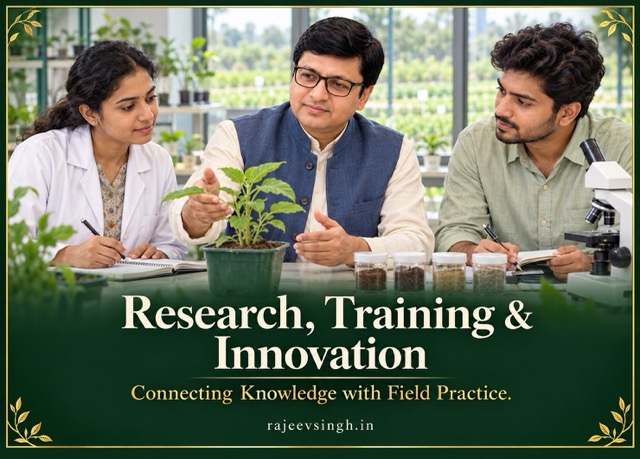
Research, Training & Innovation
Connecting Knowledge with Field Practice.
Agricultural progress begins with useful questions. How can soil support healthier crops? Which practices suit local growing conditions? How can research help farmers make better decisions, and young people build meaningful livelihoods?
For Rajeev Singh, research, training and innovation belong together. Research helps investigate problems, training makes knowledge accessible, and innovation turns learning into practical solutions. His vision connects these activities with the everyday needs of farmers, students and rural communities.
Through SIART—the Sansar Institute of Agricultural Research & Training—and associated initiatives, he seeks to strengthen the relationship between scientific knowledge, field experience and sustainable development.
Research Rooted in Real Needs
Meaningful agricultural research starts with understanding the challenges people face on the ground.
Soil degradation, inconsistent crop performance, water constraints and uncertainty about agricultural inputs require careful investigation. Farmers need guidance that accounts for their crops, resources and local conditions.
Rajeev Singh’s approach encourages dialogue among researchers, agricultural professionals and farming communities. Farmers contribute observations gathered over seasons, while researchers bring methods for testing ideas and interpreting results.
Together, these perspectives can help identify useful research questions and develop approaches worth evaluating in the field.
Soil Health and Microbial Innovation
Soil health is an important focus within this vision. Understanding the root zone, organic matter and beneficial microorganisms can inform more thoughtful agricultural practices.
Areas of interest include soil assessment, composting, biological inputs and the relationship between soil conditions and plant growth. The purpose is to explore how suitable interventions can contribute to sustainable crop management.
Microbial solutions require careful evaluation. Their suitability depends on factors such as formulation quality, storage, application and field conditions. Research and training should help users understand these requirements and assess performance realistically.
Connecting soil science with practical observation supports better decisions about what to use, where to use it and how to evaluate the response.
From Laboratory Learning to Field Evaluation
An idea that looks promising in a controlled setting still needs to be assessed under practical conditions.
Field trials and demonstrations provide opportunities to examine how an approach performs across different soils, crops, seasons and management practices. Clear objectives, appropriate comparisons and consistent records make the findings more useful.
Farmer feedback also matters. A practice must be considered in terms of labour, cost, availability and ease of use alongside its technical performance.
Rajeev Singh’s vision supports this continuing exchange between research and field experience. The aim is to help promising ideas move towards responsible adoption through evidence, practical learning and refinement.
Practical Training for Farmers
Training is most useful when participants can connect it with a decision they need to make.
A soil sample, a crop demonstration or a discussion about a recurring field problem can make agricultural concepts easier to understand. Practical sessions also give farmers space to ask questions and compare new information with their own experience.
Relevant learning areas include:
- Soil care and interpretation of soil assessments.
- Composting and management of organic resources.
- Appropriate handling and use of biological inputs.
- Crop nutrition and sustainable cultivation practices.
- Nursery management and plant establishment.
- Water management and field observation.
- Farm records and assessment of costs and results.
The objective is to strengthen the farmer’s ability to observe, evaluate and act with confidence.
Learning Opportunities for Students
Agricultural education gains depth when students engage with real growing conditions and the people who manage them.
Field visits, demonstrations, supervised projects and interactions with farmers can connect classroom concepts with practical questions. Students can learn how to record observations, identify gaps in information and communicate their findings clearly.
Through the research and training focus of SIART, Rajeev Singh encourages learning that develops curiosity alongside practical skills.
Exposure to soil health, plant care, agricultural inputs and rural enterprise can also help students identify areas in which they wish to build further expertise.
Collaboration with Universities and Researchers
Universities and research institutions contribute scientific expertise, facilities and methods for evaluating new approaches. Farmers and enterprises bring practical questions, local experience and knowledge of implementation challenges.
Connecting these strengths creates opportunities for purposeful collaboration.
Potential areas include joint field studies, student projects, technical workshops, demonstrations and the evaluation of agricultural practices. Each collaboration should begin with a defined problem, agreed responsibilities and a clear plan for recording and sharing findings.
Rajeev Singh welcomes partnerships that help agricultural knowledge reach the people who can use it, while allowing field experience to inform future research.
Innovation That Farmers Can Use
Useful innovation may be a new product, an improved process or a clearer way to deliver information.
A better composting method, more accessible training material, improved input handling or a practical crop-monitoring tool can address a genuine need. The value lies in how well the solution works for its intended users.
Digital tools also offer possibilities for organising field records, supporting advisory services and making learning resources easier to access. Their usefulness depends on reliable information, clear communication and suitability for local users.
Rajeev Singh’s approach places practical relevance at the centre of innovation. Ideas should be tested, improved through feedback and supported by guidance that helps people use them appropriately.
Supporting Agri-Entrepreneurship
Research and training can help people recognise opportunities for responsible enterprise.
Nursery development, compost production, agricultural services, produce handling and farmer education are examples of areas where practical skills may support rural businesses. Turning an idea into an enterprise also requires an understanding of customers, costs, quality and demand.
Rajeev Singh encourages aspiring entrepreneurs to begin with a clearly identified problem and a solution they can evaluate on a manageable scale.
Mentorship, institutional connections and practical exposure can help young people and farmers develop their ideas with greater clarity.
Sharing Knowledge Clearly
Knowledge becomes more useful when it is communicated in language people understand.
Demonstrations, farmer guides, workshops and educational media can explain agricultural concepts through familiar examples. Good communication also makes room for questions and acknowledges the conditions under which an approach may or may not be suitable.
Through his wider educational work, Rajeev Singh seeks to encourage informed conversations about agriculture, soil health and environmental care.
The purpose is to help people understand the reasoning behind a practice so they can make better decisions for their own circumstances.
Building Partnerships for Practical Progress
Research, training and innovation advance through shared effort.
Rajeev Singh welcomes collaboration with universities, researchers, agricultural professionals, farmer organisations, NGOs and institutions interested in practical learning and sustainable agriculture.
Opportunities may include field research, farmer workshops, student exposure, demonstration programmes, knowledge resources and mentorship for rural enterprise.
The shared goal is to connect scientific inquiry with useful skills and help promising ideas become practical contributions to farming and community well-being.
Connect, Learn and Collaborate
Whether you are a researcher seeking field engagement, an institution planning practical training or an aspiring entrepreneur exploring an agricultural idea, meaningful progress begins with a clear question and a willingness to learn.
Connect with Rajeev Singh to discuss research partnerships, training initiatives and opportunities for agricultural innovation.
Explore Research Collaboration | Discuss Training Opportunities | Connect with SIART