
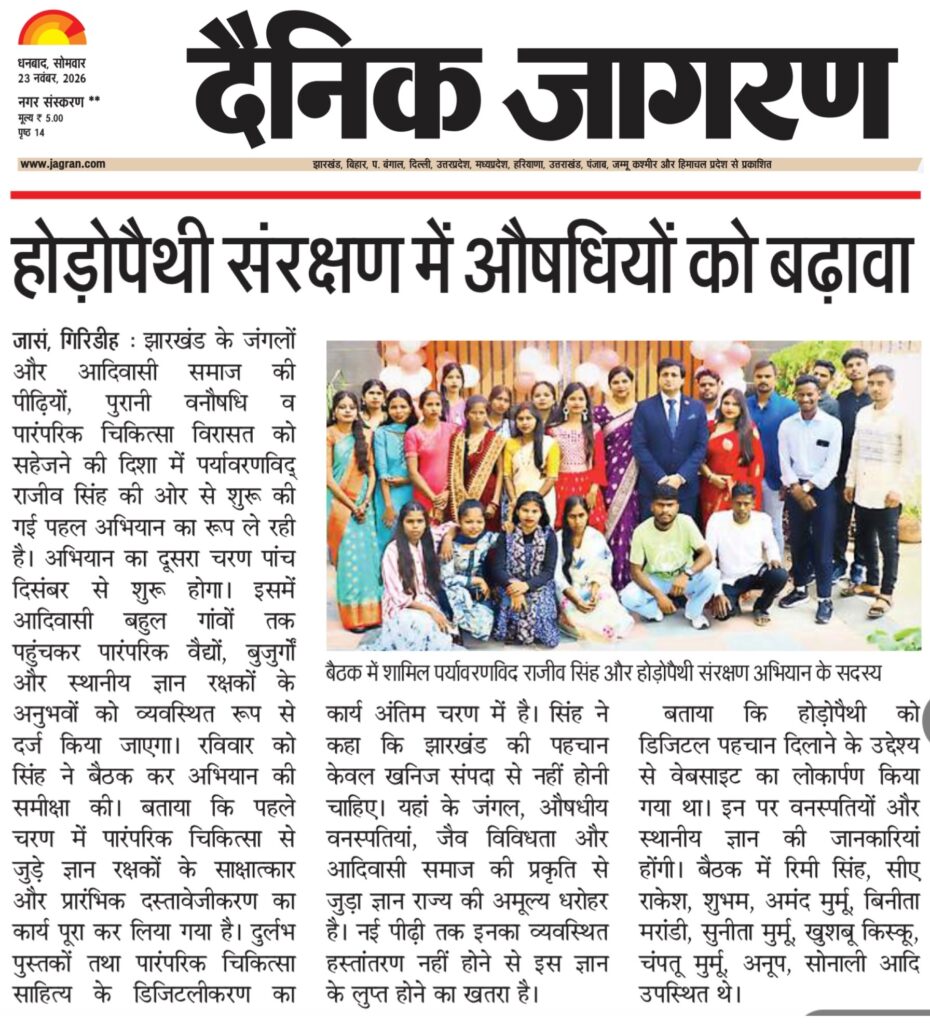
Giridih, Jharkhand: Jharkhand is known for its rich forests, mineral resources and vibrant Adivasi culture. But beyond its natural wealth lies another invaluable treasure – the traditional knowledge of indigenous communities about medicinal plants, forests and nature. Preserving this heritage has become the focus of the Hodopathy Conservation Initiative led by environmentalist and agripreneur Rajeev Singh.
The initiative has received coverage in the Dhanbad edition of Dainik Jagran on 23 November 2026 (Page 14), highlighting the efforts to document traditional Adivasi medicinal knowledge and protect the state’s indigenous plant heritage.
Through this campaign, Rajeev Singh aims to bring forgotten traditional knowledge into the public domain, connect with experienced knowledge holders and create awareness about the importance of conserving medicinal plants and biodiversity.
Preserving Knowledge That Has Survived Generations
For centuries, Adivasi communities have developed a deep understanding of their surrounding forests and natural resources. Knowledge about medicinal plants, their identification and traditional uses has been passed from elders to younger generations through experience and oral traditions.
Unfortunately, much of this knowledge still exists only in the memories and experiences of traditional healers and elderly community members. With changing lifestyles, environmental challenges and declining interaction between younger generations and traditional practices, this valuable heritage is gradually becoming vulnerable.
The Hodopathy Conservation Initiative seeks to address this concern by documenting the experiences of traditional knowledge holders and preserving their contributions for future generations.
First Phase Completed, Second Phase Begins on 5 December
The first phase of the campaign has been completed, establishing an initial foundation for the conservation and documentation work.
During this phase, interviews with traditional medicinal knowledge holders were conducted, preliminary documentation was undertaken and the digitisation of rare books and traditional medicinal literature was taken forward. The digitisation work is now in its final stage.
The second phase will begin on 5 December 2026, with a stronger focus on grassroots engagement.
The campaign plans to reach Adivasi-majority villages, interact with traditional healers and elderly community members, and document their knowledge of medicinal plants and traditional practices.
The objective is to preserve information that has been passed down orally for generations and ensure that it is not lost with time.
Jharkhand’s Identity Is More Than Its Mineral Wealth
During a review meeting, Rajeev Singh emphasised that Jharkhand’s identity should not be defined by its mineral resources alone.
The state’s forests, medicinal plants, biodiversity and the traditional knowledge of Adivasi communities are equally important parts of its heritage. These natural and cultural resources deserve greater recognition and protection.
He also highlighted the concern that if traditional knowledge is not systematically transferred to younger generations, an important part of the state’s heritage could gradually disappear.
The campaign therefore seeks to connect environmental conservation with the preservation of indigenous knowledge.
Giving Hodopathy a Digital Identity
An important milestone in this journey was achieved on 8 October 2026, when three dedicated digital platforms – Hodopathy.org, Hodopathy.in and Hodopathy.com – were inaugurated in Giridih.
These platforms aim to provide an organised space for documenting traditional medicinal plants, indigenous practices, community knowledge holders and conservation-related information.
The long-term vision is to develop a valuable digital knowledge resource that can support education, awareness and future research.
Bringing Communities and the Younger Generation Together
The success of the initiative depends on the participation of the communities that have preserved this knowledge for generations.
Traditional healers, Adivasi elders and local knowledge holders are central to the campaign. Their experiences and contributions will be documented with appropriate consent, while respecting their cultural rights and recognition.
The initiative also aims to encourage young people to learn directly from experienced community members and develop a deeper understanding of indigenous plants, forests and biodiversity.
The review meeting was attended by Rimi Singh, CA Rakesh, Shubham, Anand Murmu, Binita Marandi, Sunita Murmu, Khushbu Kisku, Champu Murmu, Anup, Sonali and other campaign members.
A Mission to Protect Heritage for Future Generations
For Rajeev Singh, Hodopathy is not simply a documentation project. It is an effort to preserve the relationship between Adivasi communities, traditional knowledge and the natural environment.
By combining community participation, digital documentation and awareness about medicinal plants, the campaign aims to create a lasting conservation movement in Jharkhand.
With the completion of the first phase and the second phase scheduled to begin on 5 December 2026, the initiative is moving towards wider community engagement and more extensive documentation.
The larger message is that Jharkhand’s real heritage extends far beyond its mineral wealth. Its forests, medicinal plants, biodiversity and indigenous wisdom are equally precious.
Preserving this knowledge today means keeping alive a legacy that belongs not only to the present generation but also to generations yet to come.
Media Coverage: Dainik Jagran, Dhanbad Edition, Jharkhand | 23 November 2026 | Page 14.