
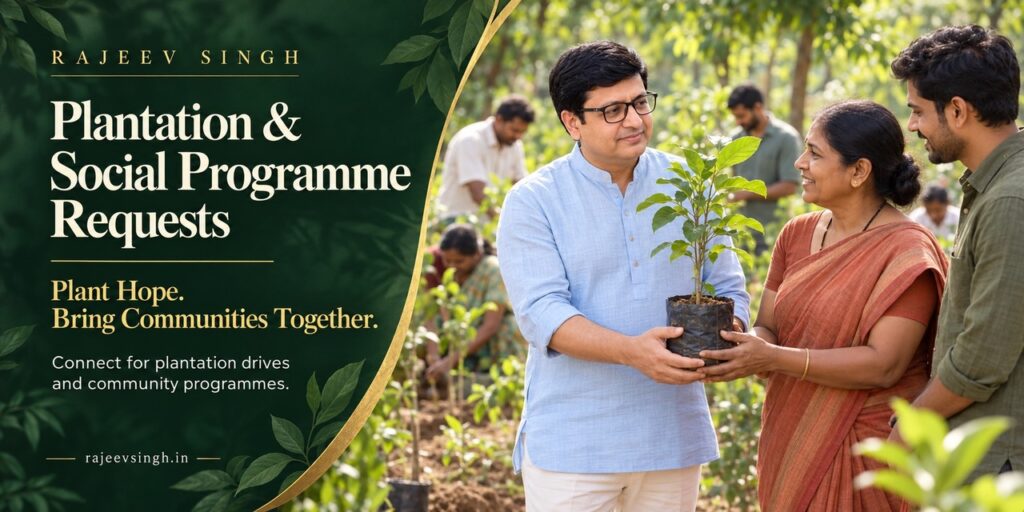
Plantation & Social Programme Requests: Project Proposal Portal
Landscape restoration and rural social transformation require clear operational planning, technical discipline, and authentic community ownership. Moving beyond token planting drives and short-term CSR events, our programs establish permanent, self-sustaining green assets that rejuvenate local ecology while anchoring livelihoods inside rural hamlets.
The Plantation & Social Programme Requests portal connects corporate CSR foundations, public sector undertakings (PSUs), district administrations, municipal bodies, and registered civil society organizations with our technical execution and monitoring network.
Whether your goal is reclaiming industrial wastelands, establishing multi-tier native Miyawaki forests, desilting community water bodies, or setting up decentralized women-led nursery enterprises, this desk serves as the formal gateway for project design and field deployment.
Program Scope & Technical Tracks
We evaluate and design proposals across four specialized intervention tracks:
                  ┌──────────────────────────────────────────────┐
                  │          Project Intervention Tracks         │
                  └──────────────────────┬───────────────────────┘
         ┌───────────────────────────────┼───────────────────────────────┐
         ▼                               ▼                               ▼
[ Harit Sansar Dense Forests ]  [ Watershed & Water Commons ]   [ Decentralized SHG Nurseries ]
  Miyawaki urban/peri-urban       Desilting earthen sumps,        Shade-net micro-units, native
  canopies and mining buffers     check dams, & bund ecology      seed banking, and income hubs
         │                                                               │
         └───────────────────────────────┬───────────────────────────────┘
                                         ▼
                      [ Regenerative Soil Clusters for FPOs ]
                         Village-level bio-enrichment units and
transition from high-cost chemicals-
1. High-Density Native Forests (Miyawaki Methodology): Turnkey development of biodiverse, multi-tier native forests on barren public tracts, institutional campuses, industrial perimeter buffers, and compacted mining overburden dumps. Engineered for high survival rates (88%+), rapid canopy closure, and particulate dust suppression.
-
2. Watershed & Water Commons Rejuvenation: Hydrological assessment, scientific desilting, deep-root vegetative bund stabilization (using native grasses and shrubs), and groundwater recharge trenching for village ponds, Aahar-Pyne networks, and dry check dams.
-
3. Decentralized Women-Led Micro-Nurseries: Financing and setting up low-cost shade-net nurseries managed by women’s Self-Help Groups (SHGs). Combines infrastructure setup, seed banking training, and guaranteed local procurement linkages for regional plantation drives.
-
4. Regenerative Soil & Bio-Input Clusters: Transforming 50- to 200-acre marginal farmer clusters under FPOs through village-scale bio-fertilizer multiplication, crop-residue composting, and microbial seed priming (Beej Sanskar).
Operational Standards & Delivery Matrix
Every project approved through this portal is executed under strict quality and audit benchmarks:
| Standard | Specification & Commitment |
| Species Integrity | Exclusively indigenous, drought-hardy forest and fruit species (Sal, Karanj, Mahua, Peepal, Neem, Bael). Monocultures and invasive ornamentals are strictly barred. |
| Soil Pre-Conditioning | Biological root-zone enrichment using beneficial nitrogen fixers, phosphorus solubilizers, and Trichoderma prior to sapling insertion. |
| Auditing & Monitoring | 24- to 36-month structured maintenance horizon with quarterly geo-tagged photo audits, canopy density reports, and third-party verifiable metrics. |
| Statutory Compliance | Complete alignment with Section 135, Schedule VII of the Companies Act, 2013 (MCA Form CSR-2 ready) and public administrative accountability norms. |
Project Lifecycle: From Submission to Field Execution
Project Request Submission Form
Institutional partners, corporate CSR teams, and administrative bodies can submit project parameters through the formal routing form below:
| Form Field | Field Guidance |
| Organization / Entity Name * | Name of Corporate, PSU, Municipal Body, NGO, or FPO |
| Authorized Contact Person * | Full name and official title/designation |
| Official Email Address * | Institutional email domain preferred |
| Contact Phone / Direct Desk * | Mobile number including country/state code |
| Program Category * | Select: Dense Native Afforestation (Miyawaki) / Water Body Desilting / SHG Nursery Setup / Regenerative Soil Cluster |
| Project Location * | District, State, and nearest landmark (e.g., Giridih, Jharkhand) |
| Land Tenure & Status * | Select: Corporate-Owned / Municipal-Public / Panchayat Commons / Forest Border / Other |
| Approximate Land Area / Scope * | e.g., 2 Acres, 10 Hectares, or 5 Water Bodies |
| Proposed Funding Mechanism * | Select: Corporate CSR Mandate / PSU Allocation / Government Convergence (MGNREGA/Smart City) / Institutional Grant |
| Target Implementation Horizon * | Select: Immediate (Within 60 Days) / Upcoming Monsoon Cycle / Next Financial Year |
| Project Synopsis & Objectives * | Outline key objectives, historical land degradation, and desired community outcomes (max 400 words) |
| Upload Site Brief / Map (Optional) | PDF or KML/KMZ site file, max 15MB |
[ Submit Project Request ]
Project Secretariat Contact
For initial consultations, pre-proposal briefings, or site survey requests:
-
Direct Email: projects@rajeevsingh.in / csr@rajeevsingh.in
-
Secretariat: Projects & Field Operations Desk, rajeevsingh.in, Giridih, Jharkhand
-
Response Cycle: Project scoping inquiries receive an initial technical evaluation and feasibility response within 5 business days.