

Academic & Scientific Gateway
Scientific progress accelerates when theoretical models and laboratory discoveries are tested against real-world field dynamics. Bridging university laboratories with living ecosystems is a core commitment of rajeevsingh.in and the Sansar Institute of Agricultural Research & Training (SIART).
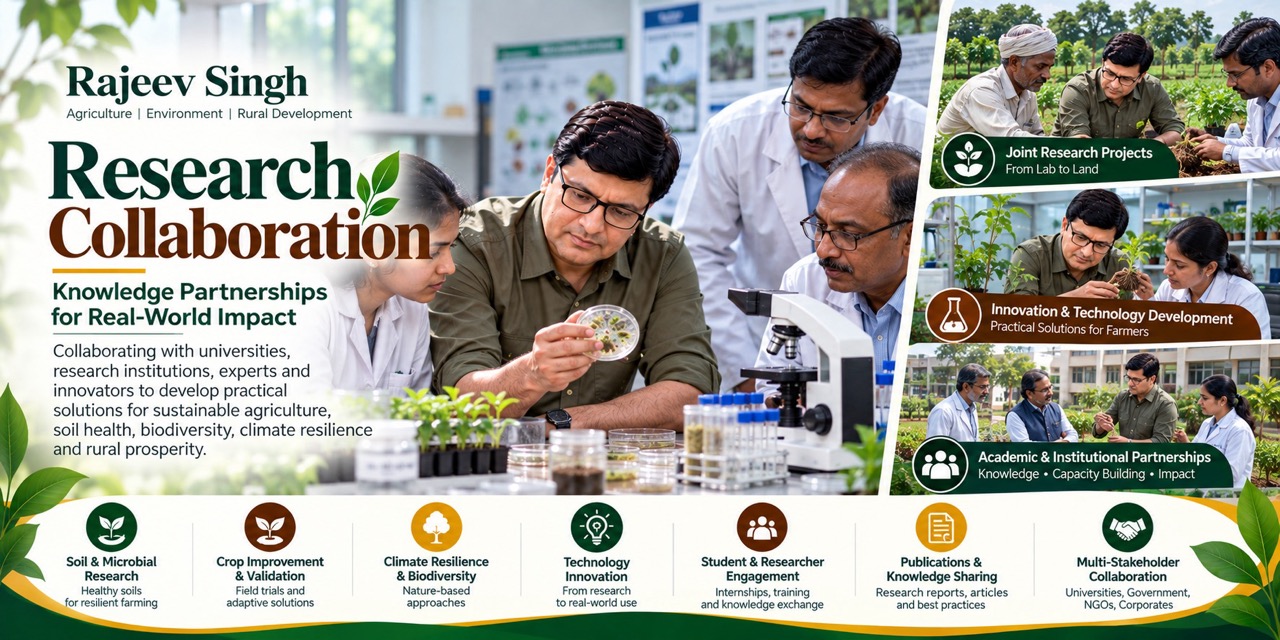
The Research Collaboration desk connects university faculties, independent scientists, postgraduate researchers, and institutional research bodies with our open-air field laboratories, indigenous microbial strain repositories, and grassroots ethnobotanical documentation programs.
Priority Research Domains
We accept collaboration inquiries and research proposals aligned with four core scientific tracks:
-
Soil Microbiology & Stress-Resilient Strains: Characterization, field evaluation, and shelf-life dynamics of microbial consortia adapted to high abiotic stress—specifically hyper-acidic soils (pH 4.5–5.5), elevated temperatures, and mineral-exhausted mining overburdens.
-
Longitudinal Soil Organic Carbon (SOC) Dynamics: Longitudinal studies tracking glomalin accumulation, root-zone fungal-to-bacterial (F:B) shifts, and deep-soil carbon sequestration under long-term bio-organic and microbial management.
-
Hodopathy & Phytochemical Validation: Taxonomic classification, herbarium documentation, and phytochemical profiling of indigenous forest botanicals across the Chota Nagpur plateau, conducted under strict prior informed consent protocols.
-
Decentralized Diagnostic Sensors & Agritech: Calibration, field benchmarking, and ruggedization of portable, battery-powered soil diagnostic analyzers measuring NPK, pH, electrical conductivity (EC), and organic matter.
What We Provide Academic Partners
Collaborating researchers and institutions gain structured access to our scientific and grassroots assets:
| Research Asset | Specifications & Availability |
| Open-Air Living Laboratories | 40+ acres of controlled trial plots across diverse soil profiles (laterite uplands, alluvial lowlands, compacted mine edges). |
| Microbial Strain Access | Research aliquots of documented beneficial strains (Azotobacter, Rhizobium, PSB, KMB, Trichoderma) for non-commercial academic trials. |
| Longitudinal Field Data | Multi-season datasets covering soil chemical, physical, and biological parameters pre- and post-microbial transition. |
| Grassroots Interface | Field logistics, farmer cluster coordination, and tribal community engagement adhering to ethical research standards. |
Guidelines for Submitting a Research Proposal
To ensure proposals receive a thorough and objective evaluation by our scientific advisory team, researchers must observe the following four-step submission protocol:
Research Proposal Submission Form
Principal investigators, university faculty, and doctoral fellows can submit collaboration proposals through the structured form below:
| Form Field | Field Guidance |
| Principal Investigator (PI) Name * | Full academic name and title |
| Designation & Department * | e.g., Associate Professor, Department of Agronomy / Biotechnology |
| University / Research Institution * | Name of accredited university, ICAR institute, CSIR lab, or college |
| Institutional Email Address * | Official academic email domain (.edu, .ac.in, .res.in, etc.) |
| Contact Phone / Direct Line * | Institutional office phone or mobile number |
| Proposed Research Track * | Select: Soil Microbiology / SOC Sequestration / Hodopathy & Phytochemistry / Agritech Sensors / Other |
| Project Title * | Clear, descriptive working title of the proposed study |
| Proposed Duration * | Select: 3–6 Months / 1 Year / Multi-Year Longitudinal (2–3 Years) |
| Executive Summary (Max 300 words) * | Outline the core scientific problem, objectives, and proposed methodology |
| Upload Concept Note (PDF, max 10MB) * | Include project design, equipment needs, and investigator CVs |
[ Submit Research Proposal ]
Intellectual Property & Ethics Charter
Research conducted through this platform is dedicated to open scientific advancement, community welfare, and the public good.
-
Non-Commercial Mandate: Strain access, living lab facilities, and field trial resources provided under academic collaborations are strictly for non-commercial research, academic publication, and public extension.
-
Protection of Traditional Knowledge: Ethnobotanical data contributed to the Hodopathy Knowledge Archivecannot be used for proprietary commercial patent filings without explicit prior informed consent and transparent community benefit-sharing frameworks.
-
Co-Authorship & Attribution: Academic publications derived from joint trials will follow standard ICMJE authorship guidelines, recognizing all participating researchers and institutional contributors fairly.
Scientific Desk Inquiries
For preliminary questions regarding lab capabilities, trial plots, or research MoUs prior to formal submission:
-
Direct Email: research@rajeevsingh.in
-
Research Secretariat: Sansar Institute of Agricultural Research & Training (SIART), Giridih, Jharkhand
-
Review Turnaround: Formal proposals receive an initial technical evaluation response within 10 to 14 business days.