
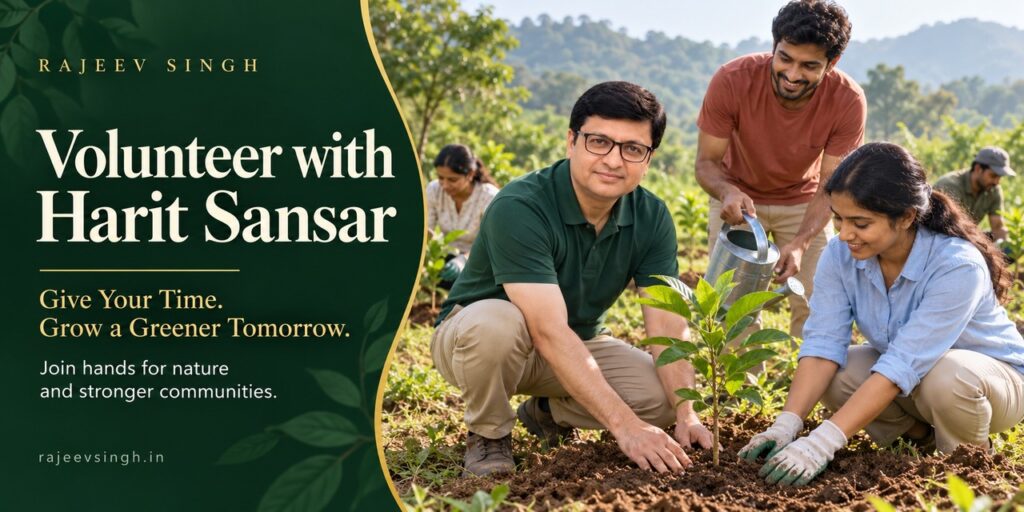
Volunteer with Harit Sansar: Ground-Level Civic Environmentalism
True ecological restoration is not a spectator sport, nor can it rely solely on administrative policy. Lasting green cover is built when citizens, students, rural youth, and working professionals step out of lecture halls and offices to touch the soil, plant living roots, and protect local natural commons.
Under the national banner of हरियाली मेरी पहचान (Greenery is My Identity), the Harit Sansar Plantation Missionmobilizes thousands of active volunteers across urban, rural, and industrial belts.
Volunteering with Harit Sansar means engaging with scientific, community-driven ecology: restoring barren stone-quarry perimeters, establishing multi-tier native Miyawaki forests, desilting lifegiving village water bodies, and documenting indigenous botanical heritage.
Four Volunteer Action Tracks
Our volunteering ecosystem offers four distinct avenues of direct involvement tailored to your skills, availability, and location:
                  ┌────────────────────────────────────────┐
                  │       Harit Sansar Volunteer Hub       │
                  └───────────────────┬────────────────────┘
         ┌────────────────────────────┼────────────────────────────┐
         ▼                            ▼                            ▼
[ Field Afforestation ]      [ Community Water ]          [ Ethnobotanical & ]
  & Native Planting Drives     & Pond Revival Drives        Biodiversity Mapping
         │                                                         │
         └────────────────────────────┬────────────────────────────┘
                                      ▼
                       [ Digital Advocacy & School ]
                          Eco-Literacy Workshops
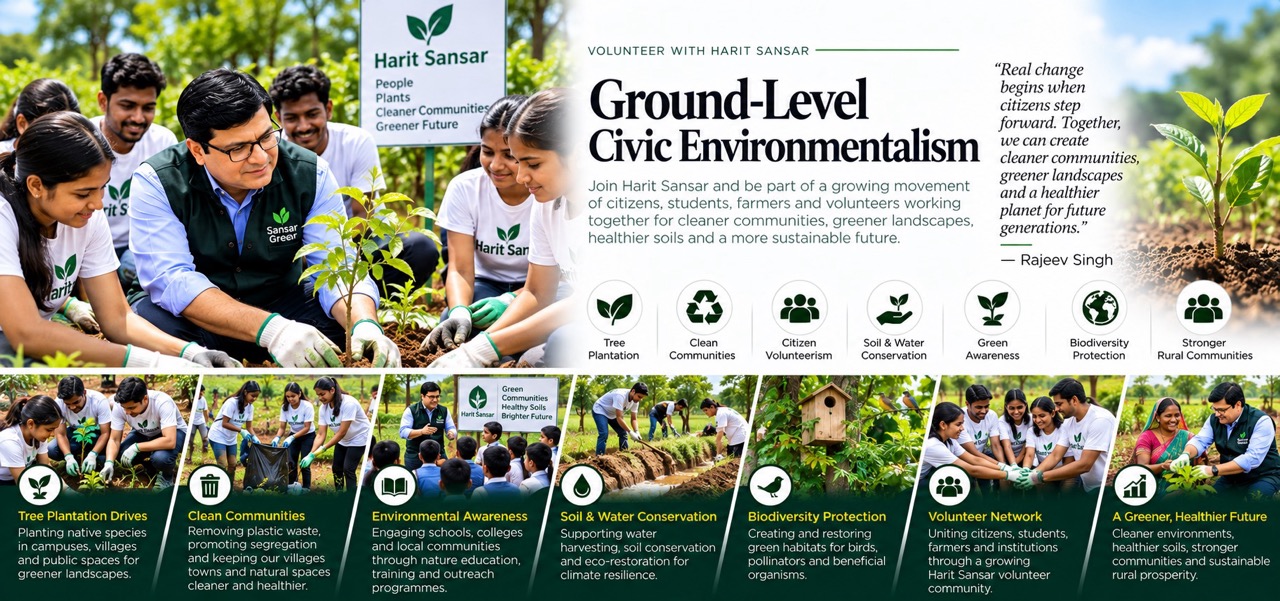
1. Field Afforestation & Dense Forest Drives
For those who want hands-on physical engagement with earth, compost, and native saplings.
-
High-Density Native Plantations: Participate in site preparation, organic biomass incorporation, and planting geometry for Miyawaki urban forests and institutional green belts.
-
Native Seed Collection Drives: Accompany field teams during seasonal harvesting of wild forest seeds (Karanj, Mahua, Neem, Sal, Haritaki, Bael) to build indigenous seed banks.
-
Post-Planting Canopy Stewardship: Assist in mulch replenishment, organic weed management, and survival tracking during the critical first 12 months of sapling establishment.
2. Water Commons & Pond Restoration Drives
For volunteers passionate about watershed resilience, rainwater harvesting, and groundwater security.
-
Catchment Desilting Workcamps: Join weekend community drives to clean and desilt traditional earthen ponds (Aahar-Pynes), check dams, and village percolation tanks before the monsoon.
-
Riparian Buffer Planting: Stabilize eroded water reservoir bunds and roadside drainage trenches using deep-rooted vetiver grasses and native soil-binding shrubs.
-
Groundwater Recharge Audits: Help map dry, silted village borewells and document seasonal water table fluctuations across peripheral rural hamlets.
3. Biodiversity Mapping & Ethnobotanical Field Logging
For botany students, researchers, photographers, and nature enthusiasts.
-
Local Flora Tagging: Work alongside village elders and healers to document wild flora and verify regional binomial nomenclature for the Hodopathy Knowledge Archive.
-
Herbarium & Photo-Documentation: Record high-resolution visual archives of wild medicinal species, native pollinator activity, and micro-forest canopy growth timelines.
-
GIS Tree-Auditing: Map geo-coordinates of newly planted saplings to maintain transparency across our real-time Impact Dashboard.
4. Eco-Literacy & Youth Outreach
For educators, writers, designers, and digital advocates.
-
Panchayat & School Workshops: Lead interactive educational sessions in government schools and rural community centers on soil health, waste composting, and plastic reduction.
-
Content & Vernacular Translation: Translate field-tested agronomic guides and environmental toolkits into local regional languages (Hindi, Santhali, Bengali).
-
Digital Campaigns: Amplify field transformations, publish volunteer photo-essays, and organize awareness campaigns under the #HariyaliMeriPehchan movement.
Volunteer Engagement Structure & Pathways
We value your time and commitment. Our engagement structure provides structured orientation, team mentoring, and clear progression:
| Volunteer Tier | Time Commitment | Core Focus | What You Receive |
| Weekend Field Steward | 4–6 Hours / Month | On-site plantation drives, pond desilting, seed collection | Field Certificate of Participation, hands-on training |
| Project Cohort Lead | 3–6 Months (4–8 Hours / Week) | Coordinating local volunteer groups, event logistics, site monitoring | Letter of Recommendation, Project Leadership Citation |
| Academic & Student Intern | 4–8 Weeks (Full/Part-Time) | Field research, GIS mapping, agronomic guide design, lab support | Formal Internship Completion Certificate, research mentorship |
| Virtual Eco-Ambassador | Flexible / Remote | Vernacular translation, graphic design, digital advocacy | National Outreach Ambassador Badge, digital portfolio credit |
The Volunteer Journey: From Registration to the Soil
Volunteer Charter & Code of Conduct
-
Ecological Integrity First: We plant only native, multi-tier species adapted to local micro-climates. We strictly avoid invasive ornamental trees.
-
Community Respect: We enter village commons as partners and learners, not external benefactors. We uphold the cultural autonomy and ancestral wisdom of local communities.
-
Leave No Trace: Every Harit Sansar field drive maintains a zero-plastic and zero-litter policy. All organic matter is recycled back into the soil.
Sign Up to Volunteer
Whether you can plant trees on alternate Sundays, map medicinal plants during vacations, or write environmental guides from home, your hands and voice are vital to expanding India’s living green canopy.
-
Volunteer Coordination Desk: volunteers@rajeevsingh.in
-
Campaign Slogan: हरियाली मेरी पहचान
-
Response Cycle: You will receive your orientation kit and upcoming project schedule within 3 working days.