
Grassroots Alliances for Agricultural & Ecological Self-Reliance
Lasting change in rural India is not delivered from corporate boardrooms or distant administrative offices—it is built from the ground up by community institutions. When local collectives lead, interventions take root: input costs fall, soil regains vitality, and village economies retain their wealth.
The NGOs, FPOs & SHGs gateway connects non-profit organizations, Farmer Producer Organizations (FPOs), women-led Self-Help Groups (SHGs), and primary village cooperatives with actionable scientific tools, field-tested capacity-building programs, and sustainable livelihood frameworks. Our goal is to replace perpetual external dependency with local technical mastery and collective economic sovereignty.
Three Pillars of Grassroots Collaboration
                   ┌────────────────────────────────────────┐
                   │    Grassroots Partnership Ecosystem    │
                   └───────────────────┬────────────────────┘
         ┌─────────────────────────────┼─────────────────────────────┐
         ▼                             ▼                             ▼
[ Farmer Producer Orgs ]     [ Women's SHG Federations ]     [ Rural NGOs & Civil Society ]
   Input Independence &         Decentralized Nurseries &       Watershed Stewardship &
   Soil Health Diagnostics      Bio-Compost Micro-Units         Sustainable Agriculture
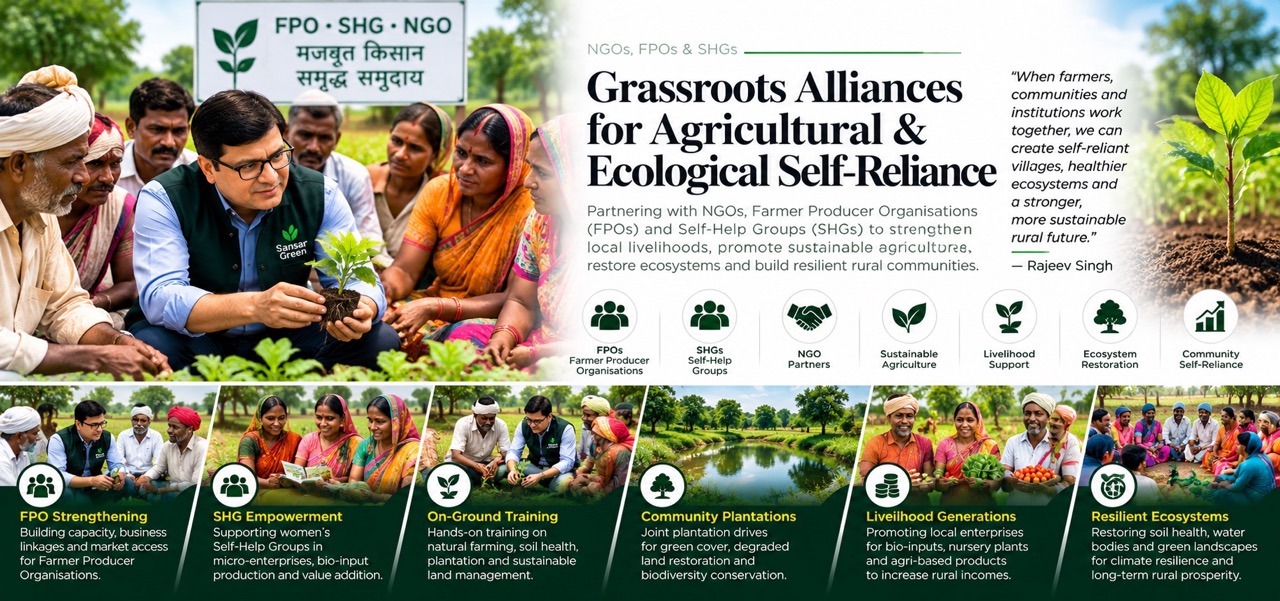
Partnering with NGOs, FPOs, and SHGs to strengthen local livelihoods, promote sustainable agriculture, and build resilient rural communities.
1. Farmer Producer Organizations (FPOs): Slashing Input Costs & Building Soil Wealth
Marginal farmers often face a double crisis: rising expenditures for chemical fertilizers and volatile market realizations. We partner with FPOs to shift their operational core from passive input distribution to biological input self-reliance and premium sustainable produce aggregation.
-
Decentralized Bio-Input Clusters: Technical training to establish community-scale bio-fertilizer multiplication, enriched farmyard composting, and liquid microbial formulation units managed by the FPO.
-
Rapid Soil Diagnostics & Farmer Passbooks: Training youth representatives to operate portable soil-testing kits (assessing pH, organic carbon, and macro/micronutrients), enabling custom, low-cost fertility advisories for member farmers.
-
Collective Market Positioning: Supporting FPOs in standardizing chemical-reduced, bio-cultivated pulses, millets, and oilseeds, qualifying them for premium clean-food markets without expensive third-party certification traps.
2. Women-Led Self-Help Groups (SHGs): Green Micro-Enterprises & Economic Dignity
Women are the primary stewards of agricultural labor and household nutrition, yet they are routinely excluded from technical training and asset ownership. Our programs enable SHGs and Mahila Mandals to establish independent ecological micro-enterprises.
-
Decentralized Native Nurseries: Equipping SHGs with basic agro-shade nets, micro-sprinklers, and native germplasm collecting skills to raise high-survival forest and fruit trees for regional afforestation drives.
-
Community Vermicomposting & Inoculation Units: Setting up micro-batch composting units that convert crop residue into living, bio-inoculated manure, supplying local village demands while generating recurring monthly income.
-
Homestead Nutrition Gardens (Poshan Badi): Providing diverse indigenous vegetable seeds and botanical pest-management recipes to eliminate reliance on market-bought produce and directly tackle maternal and child malnutrition.
3. Rural NGOs & Civil Society: Technical Backstopping for Scalable Impact
Non-profit organizations working in natural resource management often lack access to specialized microbial research, high-density afforestation protocols, or formal soil-chemistry diagnostics. We provide the technical backbone to maximize the efficacy of your on-ground projects.
-
Miyawaki Afforestation Technical Blueprints: Step-by-step guidance on site selection, deep soil excavation, biomass blending, and multi-tier species stratification for NGO-led community plantation drives.
-
Watershed & Water Body Revitalization: Hydrological and ecological planning for desilting village ponds, bund-stabilizing using deep-rooted native grasses, and establishing percolation trenches.
-
Trainer-of-Trainers (ToT) Masterclasses: Equipping field extension staff and Krishi Mitras with actionable, non-commercial agronomy modules they can immediately conduct across village chaupals.
Grassroots Partnership Matrix
| Collective Type | Primary Intervention | Technical & Resource Support Provided | Target Grassroots Outcome |
| FPOs & Cooperatives | Soil biology revival & bio-input production | Microbial mother cultures, bio-compost protocols, soil test training | 40%–60% reduction in chemical input costs across 500+ farmer members |
| Women’s SHGs | Decentralized nurseries & organic input units | Shade net blueprints, seed banking manuals, guaranteed procurement linkage | ₹8,000–₹15,000 seasonal supplemental income per member household |
| Field-Level NGOs | Landscape-scale restoration & watershed greening | Multi-tier species matrices, geo-tagged monitoring frameworks, technical DPRs | 85%+ sapling survival and permanent ecological asset creation |
| Village Forest Committees | Sacred grove (Jaherthan) & ethnomedicinal conservation | Arogya Vana planting templates, native wild herb germplasm | Preservation of local biodiversity and community healthcare access |
Partnership Framework: Four Steps to Field Implementation
Connect Your Collective
If your FPO, NGO, or SHG cluster is ready to transition to biological input independence, launch village-level green enterprises, or restore degraded community commons, connect with our grassroots coordination desk:
-
Desk: Grassroots Partnerships & Cooperative Outreach, rajeevsingh.in
-
Direct Channel: grassroots@rajeevsingh.in
-
Response Cycle: Project scoping notes and training consultation scheduled within 3 to 5 working days.