
Universities & Researchers: Bridging Academic Science with Field Application
Pioneering agronomic science and ethnobotanical discovery must not remain confined to controlled laboratory growth chambers or high-impact journals. The most critical environmental challenges of our time—rebuilding degraded topsoils, unlocking locked soil phosphorus, adapting crops to erratic weather patterns, and preserving fragile forest ethnopharmacopeias—require continuous, multi-disciplinary exchange between institutional research and living field ecosystems.
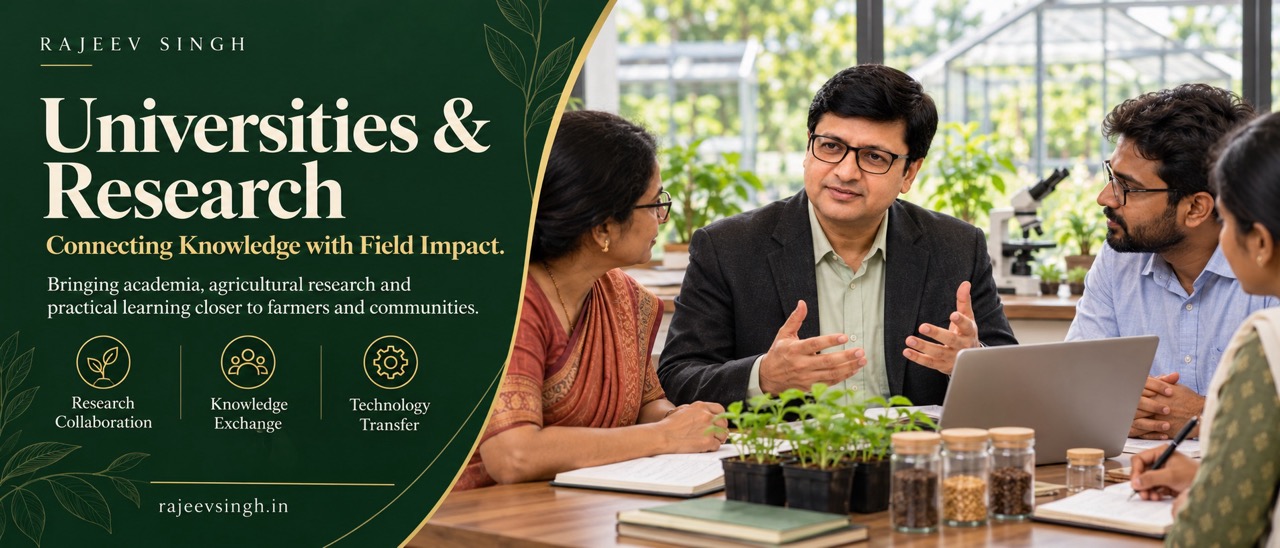
Through the Universities & Researchers collaboration portal, rajeevsingh.in partners with agricultural universities, engineering institutes, biotechnology departments, and independent social scientists. We offer open-air living laboratories, verified field trial networks, access to indigenous microbial strain repositories, and direct interface with rural farming collectives across eastern India.
Core Areas for Academic & Scientific Collaboration
               ┌────────────────────────────────────────────────────────┐
               │         Academic Research Collaboration Areas          │
               └──────────────────────────┬─────────────────────────────┘
         ┌──────────────────┬─────────────┴─────────────┬──────────────────┐
         ▼                  ▼                           ▼                  ▼
[ Microbial Ecology & ] [ Soil Carbon & ]     [ Ethnobotany & ]     [ Agritech & IoT ]
  Strain Bio-Prospecting  Regenerative Agronomy  Hodopathy Archive     Low-Cost Diagnostics
-
Microbial Ecology & Stress-Tolerant Bio-Inoculants: Joint investigation, molecular characterization, and field evaluation of beneficial microbial consortia capable of surviving severe abiotic stress—such as hyper-acidic soils (pH 4.5–5.5), high temperatures, and degraded mining-affected soils.
-
Soil Organic Carbon (SOC) & Nutrient Sequestration Dynamics: Longitudinal field studies evaluating root-zone microbiology, fungal-to-bacterial (F:B) ratios, glomalin production, and multi-year carbon immobilization under low-chemical, bio-enriched agricultural regimes.
-
Ethnobotany & Hodopathy Phytochemical Validation: Scientific profiling, taxonomy, and bio-active screening of indigenous medicinal plant species documented in the Chota Nagpur plateau, ensuring full compliance with the Nagoya Protocol on Access and Benefit Sharing (ABS).
-
Appropriate Agritech & Decentralized Soil Diagnostics: Field validation, calibration, and iterative refinement of low-cost, portable soil-testing devices (such as multi-parameter NPK, pH, and electrical conductivity sensors) designed for direct deployment by rural extension agents.
Collaboration Frameworks
We provide structured engagement models tailored to faculty investigators, institutional departments, and postgraduate/doctoral researchers:
| Track | Engagement Model | Resource & Field Commitments | Target Outcomes |
| Track 1: Joint Research Projects & Grant Proposals | Institutional MoU between university departments and SIART research desks | Access to long-term demonstration plots, multi-season crop trials, and regional germplasm collections. | Joint grant submissions (DST, DBT, ICAR), co-authored peer-reviewed papers, and open-access technical bulletins. |
| Track 2: PhD & Postgraduate Field Fellowships | Supervised field-study residency and research access | Direct hosting at trial farms and village clusters, logistic field support, and community coordination. | Doctoral dissertations, field trials, and applied research datasets with real-world smallholder impact. |
| Track 3: Technology Transfer & Strain Inoculation Validation | Bilateral agreements for field-scale validation of academic innovations | In-vivo multi-location testing of lab-developed strains or biostimulants across marginal farms. | Efficacy benchmarking, protocol standardization, and adaptation of laboratory prototypes to farm conditions. |
| Track 4: Ethnobotanical Documentation & Prior Art Archiving | Multidisciplinary research teams (Anthropology, Botany, Pharmacology) | Co-led field documentation alongside indigenous healers (Rarhanik and Kaviraj). | Taxonomic botanical registries, chemical fingerprinting, and ethical prior-art publication to prevent biopiracy. |
Field Research Infrastructure & Resources Available
Academic collaborators gain access to an established rural and laboratory infrastructure designed to bridge scientific inquiry and community adoption:
-
Open-Air Living Laboratories: Over 40 acres of dedicated field trial plots across varying micro-climates and soil conditions (laterite uplands, alluvial lowlands, and industrial perimeter lands).
-
Baseline Historical Datasets: Longitudinal data tracking soil biological, physical, and chemical parameters across multi-year microbial transitions and high-density native afforestation sites.
-
Grassroots Community Interface: Direct working relationships with over 28 women-led Self-Help Group (SHG) nursery clusters and dozens of village farmer collectives for verified field survey research.
-
Controlled Inoculation & Culture Banking: Technical coordination through the Sansar Institute of Agricultural Research & Training (SIART) repository of localized, acid-tolerant bio-inoculants.
Institutional Research Protocol & Ethics Charter
To protect academic integrity and community sovereignty, all university collaborations operate under strict research protocols:
Propose a Research Collaboration
Deans of research, university professors, and doctoral scholars seeking to establish field trials, propose joint research grants, or access the Hodopathy and SIART research archives can initiate contact with our research liaison team:
-
Desk: Academic & Scientific Collaboration Secretariat, rajeevsingh.in
-
Direct Channel: research@rajeevsingh.in
-
Review Cycle: Academic proposals are reviewed by our scientific advisory committee within 10 working days.