
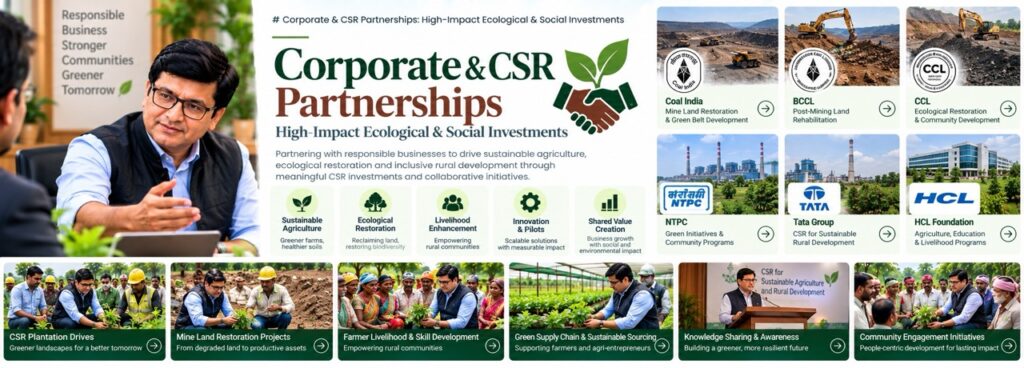
High-Impact Ecological & Social Investments
Corporate Social Responsibility (CSR) is most effective when it moves beyond compliance to create lasting, regenerative assets for communities and ecosystems. In an era of increasing Environmental, Social, and Governance (ESG) scrutiny, corporate sustainability mandates demand verifiable outcomes: high plant survival rates, revitalized water tables, and economically empowered rural communities.
Through the Corporate & CSR Partnerships gateway, rajeevsingh.in partners with forward-looking public and private enterprises to design, execute, and monitor turnkey environmental and social projects. Every initiative combines scientific methodology with community-led stewardship, ensuring projects remain audit-compliant, socially transformative, and ecologically permanent.
Alignment with Schedule VII (Companies Act, 2013) & ESG Goals
Our partnership models align directly with statutory mandates under Section 135, Schedule VII of the Companies Act, 2013:
┌────────────────────────────────────────────────────────────────────────┐
│                        CSR Alignment Framework                         │
├──────────────────────────┬──────────────────────────┬──────────────────┤
│ Schedule VII Category    │ Flagship Field Program   │ Core ESG Metric  │
├──────────────────────────┼──────────────────────────┼──────────────────┤
│ Item (iv): Environmental │ Harit Sansar Plantation  │ Carbon Sinks &   │
│ Sustainability & Soil/   │ Mission & Industrial     │ Biodiversity     │
│ Water Conservation       │ Buffer Afforestation     │ Index (E)        │
├──────────────────────────┼──────────────────────────┼──────────────────┤
│ Item (ii) & (iii): Women │ Decentralized Village    │ Livelihoods &    │
│ Empowerment, Livelihoods │ Nurseries & Micro-Input  │ Gender Equity    │
│ & Rural Vocational Skills│ Enterprises (SHGs)       │ (S)              │
├──────────────────────────┼──────────────────────────┼──────────────────┤
│ Item (x): Rural          │ Community Catchment &    │ Water Table &    │
│ Development Projects     │ Check-Dam Rejuvenation   │ Farm Resilience  │
│                          │ Schemes                  │ (S & G)          │
└──────────────────────────┴──────────────────────────┴──────────────────┘
Turnkey CSR Program Tracks
We offer four structured, audit-ready operational programs designed for multi-year corporate investment:
1. Industrial Buffer Greening & Miyawaki Native Forests
-
Scope: Transforming barren industrial perimeters, thermal/cement plant buffer corridors, and mined-out overburden dumps into high-density, multi-layer native forests.
-
Methodology: Multi-tier planting (canopy trees, sub-canopy, shrubs, and native ground cover) conditioned with indigenous microbial inoculants.
-
Corporate Value: Particulate matter ($PM_{2.5}$ / $PM_{10}$) mitigation, rapid carbon sequestration, natural noise attenuation, and green-belt compliance.
2. Decentralized Women-Led Nursery Micro-Enterprises
-
Scope: Funding village-level shade net nurseries managed entirely by women’s Self-Help Groups (SHGs) in mine-adjacent and marginal rural hamlets.
-
Methodology: Corporate capital provides shade net infrastructure, micro-sprinklers, and nursery inputs. The SHG is trained to supply native saplings for regional greening missions.
-
Corporate Value: Demonstrable social impact, measurable household income generation, and gender-focused economic empowerment with sustainable local asset creation.
3. Catchment Desilting & Rural Water Security
-
Scope: Rejuvenating silted community water bodies (Aahar-Pynes, earthen ponds, and check dams) in water-stressed agricultural belts.
-
Methodology: Scientific desilting, deep-root vegetative bund stabilization using native grasses and trees, and groundwater percolation trenching.
-
Corporate Value: Water replenishment credits, community goodwill across plant catchments, and heightened climate resilience for local agriculture.
4. Regenerative Soil Health & Farmer Cluster Enablement
-
Scope: Transitioning 100- to 500-acre clusters of marginal farmers from high-cost chemical fertilizers to bio-organic and microbial practices.
-
Methodology: Baseline soil profiling, establishment of low-cost village-level bio-enrichment beds, and comprehensive training in microbial seed priming (Beej Sanskar).
-
Corporate Value: Input cost reduction for smallholders, improvement of Soil Organic Carbon (SOC), and development of regional bio-agricultural models.
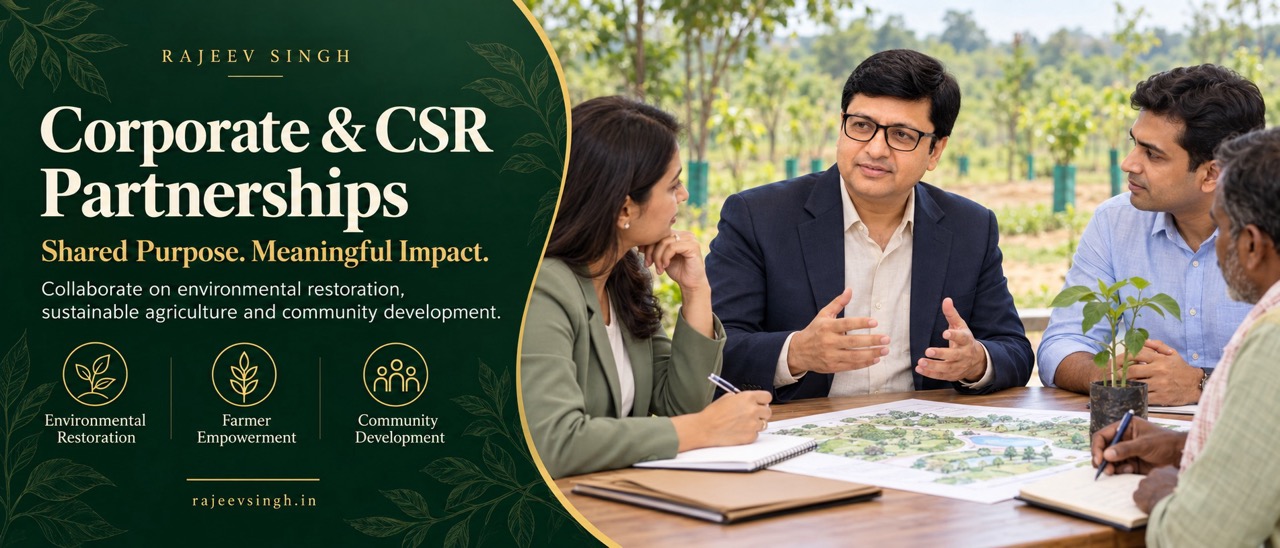
Building corporate and CSR partnerships for environmental restoration, sustainable agriculture, farmer empowerment and community development.
Corporate Proposal Framework & Project Lifecycle
To guarantee transparency, seamless execution, and statutory audit compliance, every CSR partnership adheres to a five-stage operational framework:
Why Leading Corporates Partner with Us
-
High Verified Survival Rates: Our ecological planting models consistently maintain 88%+ survival rates across challenging laterite and mined soils through microbial root enrichment and rigorous maintenance frameworks.
-
Community-Embedded Execution: By anchoring projects in local SHGs and farmer collectives, we prevent the “plant-and-abandon” syndrome common in transactional commercial contracts.
-
Data-Backed Reporting: Corporate CSR boards receive audit-ready documentation, GIS-mapped site data, photographic progress logs, and measurable socio-economic performance metrics.
-
Zero Commercial Cross-Contamination: Projects funded via CSR through this platform remain dedicated to public service, non-profit community assets, and verified ecological restoration.
Key Deliverables Matrix for CSR Partners
| Parameter | Milestone 1 (Months 1–3) | Milestone 2 (Months 4–12) | Milestone 3 (Months 13–24) | Milestone 4 (Month 36) |
| Site Progress | Baseline soil report, site grading, micro-irrigation setup | Dense plantation complete, initial mulching & bio-enrichment | Canopy consolidation, multi-tier vegetation established | Self-sustaining micro-forest canopy or functioning water body |
| Community | SHG identification, village panchayat consent secured | Nursery batch operational, on-ground training completed | Livelihood revenues disbursed, compost beds active | Independent community management committee established |
| Documentation | Approved DPR, signed MoU, baseline data sheet | Mid-term geo-tagged audit report, expense utilization | Annual impact evaluation report, carbon sink projection | Final Project Completion Report & CSR-2 compliance filing |
Initiate a CSR Partnership Proposal
CSR directors, ESG leads, and corporate affairs heads can connect directly with our partnership secretariat to request site surveys, concept notes, or customized project blueprints.
-
Office: Corporate & CSR Partnerships Desk, rajeevsingh.in
-
Direct Channel: csr@rajeevsingh.in
-
Turnaround: Initial project consultation and preliminary concept note delivered within 7 working days.