
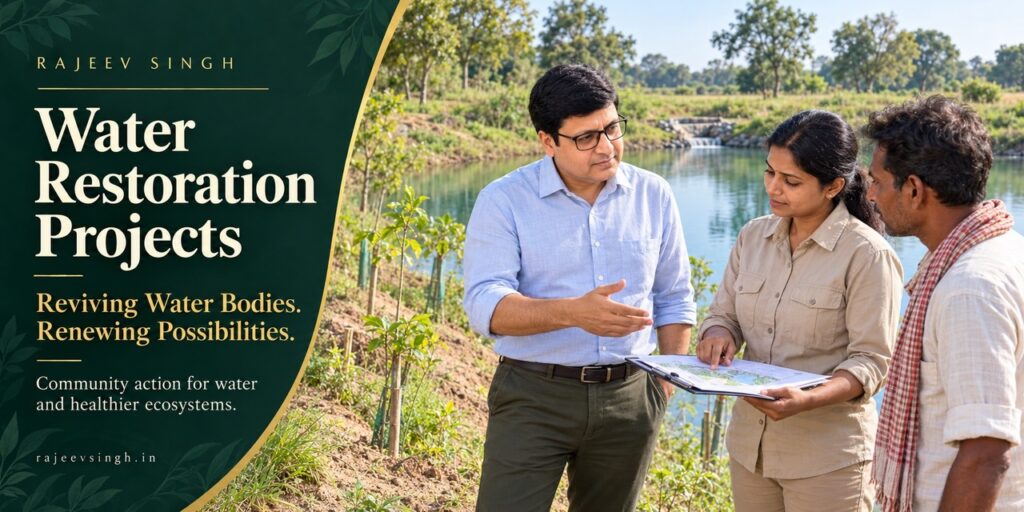
Reviving Water. Restoring Ecological Balance.
Water bodies are essential community assets.
Ponds, lakes, wetlands and local drainage systems support groundwater recharge, agriculture, biodiversity, climate resilience and public well-being. When they are neglected, polluted, encroached upon or disconnected from their natural catchments, entire communities are affected.
Rajeev Singh’s Water Restoration Projects support practical, ecological and community-led approaches to protect and revive local water ecosystems.
[Partner for Restoration] [Request a Project Discussion]
Our Project Purpose
To help restore and protect water bodies and surrounding ecosystems through ecological planning, plantation, biodiversity support, public awareness and long-term community participation.
The focus is not only on improving a water body’s appearance. It is to strengthen its ecological role and value for people, farms, wildlife and future generations.
Types of Water Restoration Projects
Community Pond Restoration
Projects that support the revival of village ponds through site understanding, cleaning, appropriate restoration planning, green buffers, community awareness and ongoing protection.
Lake and Wetland Conservation
Initiatives that focus on protecting lakes, wetlands and surrounding ecological areas that support water storage, birds, aquatic life, local biodiversity and climate resilience.
Green Buffer Development
Plantation of suitable native trees, grasses and vegetation around water bodies to help reduce erosion, protect soil, improve habitat and strengthen the local landscape.
Watershed and Catchment Awareness
Community programmes that help people understand how rainfall, drainage, soil, vegetation and land use affect water availability and groundwater recharge.
Degraded-Land and Mining-Area Restoration
Ecological approaches for suitable degraded land, involving native vegetation, soil improvement, plantation, water management and long-term restoration planning.
Institutional Water Conservation
Projects for campuses, schools, industries, offices and public institutions focused on green infrastructure, rainwater awareness, plantation and responsible water practices.
Our Restoration Project Model
1. Understand the Site
Every project begins with site-level understanding.
This includes the water body’s condition, catchment, soil, water flow, surrounding land use, existing vegetation, local biodiversity, pollution issues and community needs.
2. Develop an Ecological Plan
The project plan may include appropriate restoration measures, green-buffer plantation, erosion control, biodiversity support, cleaning awareness, catchment protection and long-term maintenance.
3. Involve the Community
Water restoration cannot succeed without local ownership.
Farmers, residents, students, panchayats, institutions, volunteers and community groups are encouraged to participate in awareness, plantation, protection and monitoring activities.
4. Build Green Protection
Suitable vegetation and plantation around water ecosystems can help stabilise soil, improve habitat, reduce erosion and support ecological recovery.
5. Protect and Monitor
Follow-up is essential. Projects should include maintenance responsibility, public awareness, waste-management practices, plantation care and periodic review.
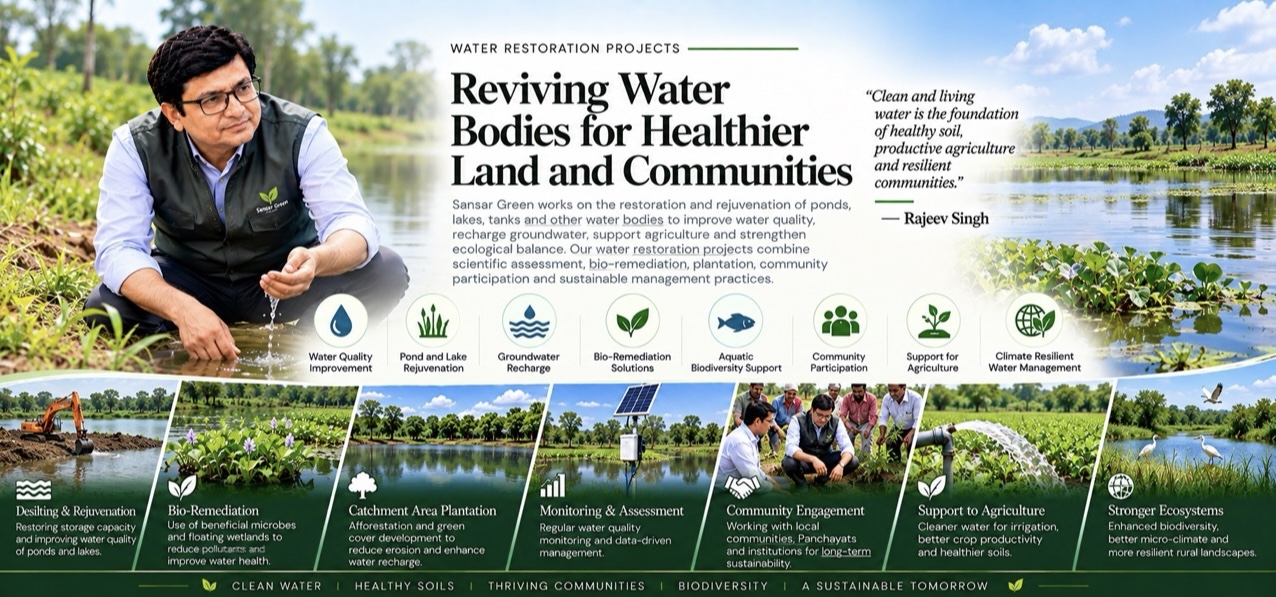
Clean and living water is the foundation of healthy soil, productive agriculture and resilient communities.
Water, Soil and Biodiversity Are Connected
Water restoration works best when linked with broader ecological action.
- Trees protect soil and support water infiltration.
- Healthy soil retains moisture and reduces erosion.
- Wetlands support birds, fish, insects and plant diversity.
- Community participation protects water bodies over the long term.
- Sustainable farming reduces pressure on local ecosystems.
For this reason, Water Restoration Projects work alongside Harit Sansar plantation, SIART research and farmer-awareness programmes.
What We Document
Each water restoration project should include:
- Project name, location and date
- Site condition and local challenge
- Partner institutions and community participants
- Restoration and plantation activities
- Photographs before, during and after work
- Species and green-buffer details
- Maintenance and protection plan
- Follow-up observations and learning
Only verified project data, photographs and records should be used for public impact reporting.
Partner With Us
We welcome collaboration from:
- Panchayats and village communities
- Government departments and public institutions
- Universities and schools
- Corporate CSR partners
- NGOs and environmental organisations
- Resident and citizen groups
- Farmer groups and FPOs
- Industry and campus-management teams
Together, we can turn neglected water bodies into protected community assets.
[Submit a Water Restoration Enquiry] [Partner With Us] [Contact Us]
Restore Water, Secure the Future
Every restored pond, protected wetland and green water buffer helps create a more resilient India.
Let us protect the water systems that support our farms, communities, biodiversity and future generations.
[Explore Eco Restoration] [View Impact & Projects] [Contact Us]