
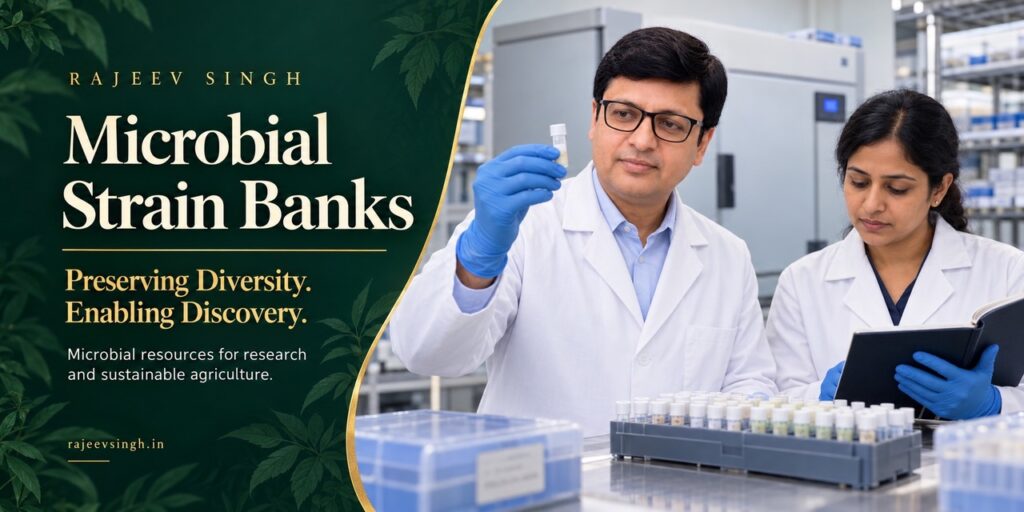
Local Microbes for Healthier Soil and Stronger Farms
India’s soils are diverse.
A soil in Jharkhand may differ significantly from a soil in Bihar, Punjab, Maharashtra, Assam or any other region. Climate, temperature, rainfall, pH, organic matter, crop history and local biodiversity all influence the microbial life that supports plant growth.
SIART’s Microbial Strain Bank initiative is built on this understanding.
The initiative works toward identifying, studying, conserving and developing beneficial microbial resources suited to different soil and agro-climatic conditions. The aim is to support the development of more relevant, science-led and farmer-friendly biological solutions for Indian agriculture.
[Partner for Research] [Explore Microbial Farming]
What Is a Microbial Strain Bank?
A microbial strain bank is a research resource that maintains beneficial microorganisms for scientific study, evaluation and future agricultural application.
In agriculture, beneficial microorganisms can play an important role in soil processes, nutrient availability, root-zone health, organic-matter cycling and plant resilience.
The purpose of a strain bank is not simply to collect microorganisms. It is to create a responsible, well-documented research foundation for understanding how suitable microbes may support healthier soils and sustainable crop production.
Why Region-Specific Microbial Research Matters
A single bio-input may not perform equally in every field.
Farmers work with different soils, crops, temperatures, rainfall patterns, water availability and local ecological conditions. These differences can influence whether a microbial solution is suitable, effective and practical for a particular farm.
SIART’s approach is based on the principle that soil health solutions should be informed by local conditions.
This is why the Microbial Strain Bank initiative focuses on:
- Soil and agro-climatic diversity
- Local crop systems
- Beneficial microbial potential
- Scientific evaluation and quality standards
- Field-level relevance
- Responsible research and farmer validation
Our Research Objective
The long-term objective is to support the development of area-specific microbial solutions that help farmers improve soil health, nutrient-use efficiency and sustainable crop production.
The initiative seeks to create a knowledge base that connects soil science, microbiology, field learning, farmer experience and agricultural innovation.
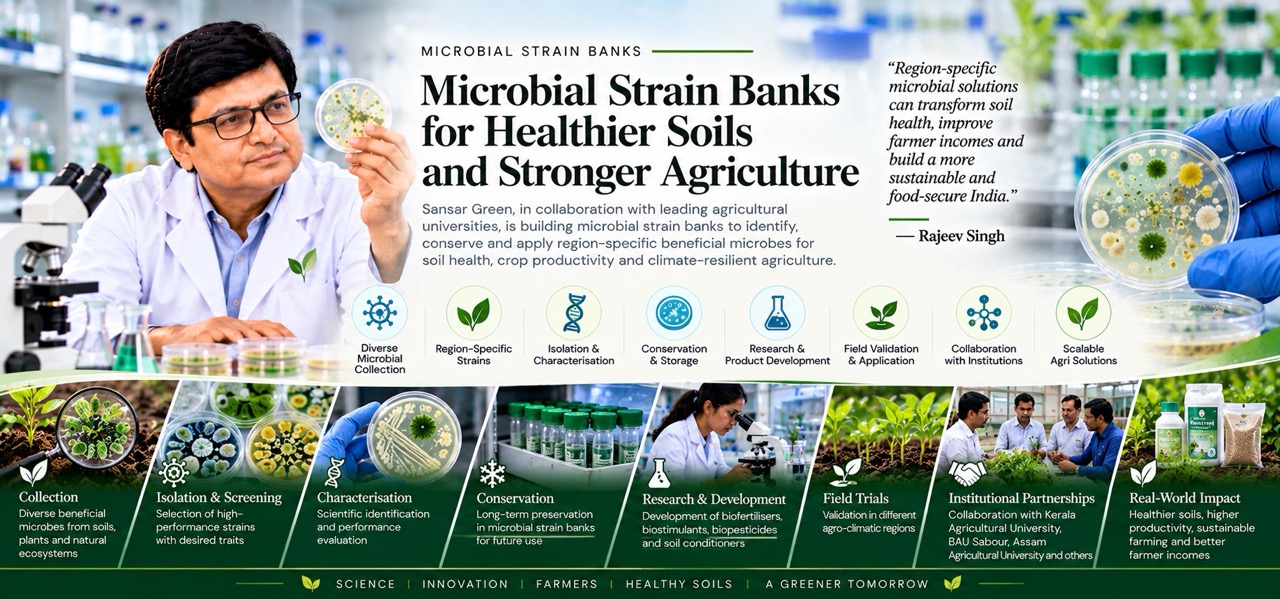
Region-specific microbial solutions transform soil health, improve farmer incomes, and build a sustainable and food-secure India.
The SIART Approach
1. Understanding Local Soil Conditions
Research begins with an understanding of the soil, crop, climate and field context. This may include soil-health assessment, farming-practice observations and identification of local agricultural challenges.
2. Identifying Beneficial Microbial Potential
Potentially useful microorganisms are studied through responsible research processes to understand their relevance for soil and crop systems.
3. Documentation and Preservation
Microbial resources are documented, maintained and evaluated within appropriate scientific, quality and biosafety practices.
4. Research and Product Development
Suitable microbial resources may contribute to research on biofertilisers, biostimulants, soil-health solutions and sustainable crop-support systems.
5. Field Validation
Research findings must be tested and assessed in practical field conditions through carefully designed trials, demonstrations and farmer feedback.
6. Farmer Training and Knowledge Transfer
The purpose of this work is to translate research into understandable, responsible and practical guidance for farmers.
Potential Areas of Application
The Microbial Strain Bank initiative can support research related to:
- Soil fertility and nutrient cycling
- Nitrogen, phosphorus and potassium availability
- Root-zone health
- Organic-matter management
- Biofertiliser development
- Biostimulant and crop-support solutions
- Climate-resilient agriculture
- Crop-specific and soil-specific recommendations
- Sustainable alternatives to excessive chemical-input dependence
Any agricultural product, recommendation or commercial application must follow applicable quality, safety, regulatory and scientific-validation requirements.
From Strain Bank to Farmer Field
The journey from research to the field requires care and accountability.
SIART follows a farmer-focused pathway:
Research → Evaluation → Quality Development → Field Trials → Farmer Demonstration → Training → Responsible Adoption
This approach is designed to ensure that innovation is not disconnected from the realities of farmers’ fields.
Collaboration for Science and Impact
Microbial research requires collaboration among scientists, agricultural universities, laboratories, farmer groups, startups and institutions.
SIART welcomes opportunities to work with research partners on:
- Soil microbiology research
- Microbial resource evaluation
- Field trials and demonstrations
- Bio-input innovation
- Farmer training
- Agro-climatic research
- Technology transfer
- Sustainable agriculture programmes
The broader research ecosystem includes SIART’s stated engagement with institutions such as IIT (ISM) Dhanbad and Bihar Agricultural University, Sabour.
[Collaborate With SIART]
A Responsible Research Commitment
SIART is committed to a responsible approach to microbial research.
This includes:
- Scientific documentation
- Quality and traceability
- Appropriate biosafety and regulatory practices
- Ethical research collaboration
- Field validation before recommendations
- Clear communication with farmers
- Continuous learning through research and feedback
Building India’s Living Soil Future
Microbial Strain Banks represent a long-term investment in India’s agricultural future.
By understanding the living biology of soil and developing solutions suited to local conditions, SIART aims to help build farms that are healthier, more resilient and more productive.
Living soil is the foundation of sustainable agriculture.
[Explore SIART Research] [Partner for Field Trials] [Contact Us]