
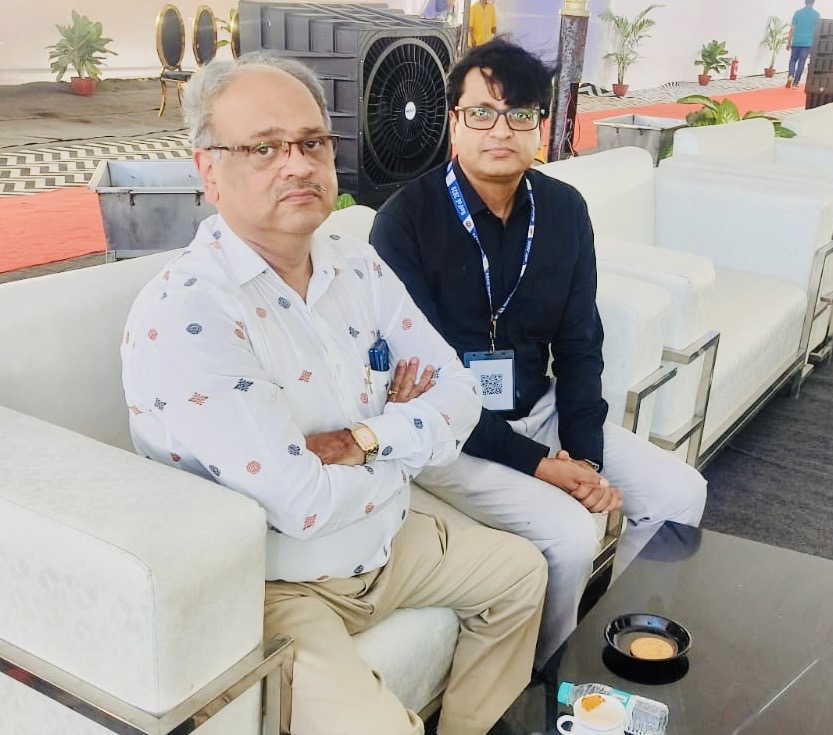
From Giridih to IIT (ISM): Rajeev Singh Explores the Future of Farmer-Centric Soil Technology with Prof. Sukumar Mishra
A conversation on soil health, practical innovation and taking agricultural technology closer to the farmer
Dhanbad | 9 August 2026
What happens when a local agricultural challenge meets the expertise of one of India’s leading technical institutions?
That question was at the heart of a meaningful interaction between Rajeev Singh, Director of Sansar Green Mission Pvt. Ltd., and Prof. Sukumar Mishra, Director, IIT (ISM) Dhanbad, during the 20th Symposium on National Frontiers of Engineering (NatFoE) and Innovation in Manufacturing Practices (IMP) 2026.
The interaction brought together two important perspectives—scientific and technological expertise on one side, and field-oriented agricultural entrepreneurship on the other—with soil testing and farmer-focused technology at the centre of the conversation.
Turning a farm challenge into a technology opportunity
For farmers, understanding the condition of soil is fundamental to making better decisions about crops and nutrient management. Yet the value of soil science depends largely on how easily its information can be translated into practical action.
Rajeev Singh shared the concept of a soil-testing prototype being explored through Sansar Green Mission. The idea is focused on making soil assessment more practical and accessible while helping farmers understand their soil requirements in a simpler way.
The discussion with Prof. Sukumar Mishra explored how technology can potentially bridge the gap between scientific soil assessment and everyday farm-level decision-making.
Technology must work for the farmer
A central theme of the interaction was the importance of farmer-centric innovation.
Agricultural technology can have a meaningful impact only when it addresses an actual problem faced by farmers. Solutions therefore need to combine scientific reliability with simplicity, practicality and ease of use.
Rajeev Singh emphasised the importance of developing technology around the farmer rather than expecting farmers to adapt to complicated technology.
The objective is to make scientific information more understandable and actionable so that farmers can use it while planning crop nutrition and soil management.
A national platform for a local idea
The interaction took place at IIT (ISM) Dhanbad during a national symposium that brought together scientists, researchers, academicians, engineers, industry representatives and innovators from across India.
For Rajeev Singh, the event provided an opportunity to take an agricultural technology concept emerging from Giridih into a wider scientific and technological ecosystem.
The significance goes beyond one meeting. It demonstrates how ideas originating from smaller cities and districts can enter conversations taking place at premier national institutions.
Connecting science with the field
One of the larger challenges in agricultural innovation is creating a strong connection between research and practical farming.
Scientific institutions generate knowledge and technologies, while farmers face real-world challenges every day. Agricultural entrepreneurs can play an important role in connecting these two worlds.
The conversation between Prof. Sukumar Mishra and Rajeev Singh reflects the potential of such connections—where engineering, research, entrepreneurship and agriculture can come together around a specific field-level problem.
Why soil testing matters
Soil is more than the medium in which crops grow. Its physical, chemical and biological characteristics influence nutrient availability, crop performance and long-term agricultural sustainability.
Better access to soil information can help farmers make more informed decisions and avoid indiscriminate nutrient application.
The soil-testing concept being explored by Rajeev Singh aims to contribute to this approach by making soil-related information more useful at the farmer level.
Jharkhand’s emerging AgriTech potential
The interaction also highlights the growing potential of Jharkhand as a centre for agricultural entrepreneurship and innovation.
Giridih and other districts across the state have agricultural challenges that can become opportunities for locally relevant technology development.
When entrepreneurs from these regions engage with institutions such as IIT (ISM) Dhanbad, it creates opportunities for knowledge exchange, technical guidance, research collaboration and further innovation.
Beyond a meeting
The significance of the interaction lies not only in the exchange of ideas but in the possibilities that such conversations can create.
For Sansar Green Mission, the direction is towards developing agricultural solutions that are scientifically informed but firmly connected to farmers’ needs.
For Rajeev Singh, the journey from Giridih to a national technology platform is part of a broader effort to bring agricultural challenges into conversations around science, engineering and innovation.
Looking towards the next step
The soil-testing concept will require continued technical development, validation and field-oriented refinement before its wider application.
The interaction at IIT (ISM) Dhanbad provides an important platform for exchanging perspectives and exploring how agricultural technology can become more relevant, accessible and useful for farmers.
As India looks towards technology-driven and sustainable agriculture, the convergence of scientific institutions, entrepreneurs and farmers will become increasingly important.
The message from Giridih is simple: innovation should not stop at identifying a problem—it should move towards creating a solution that works in the field.