
Dhanbad, Jharkhand | July 2026
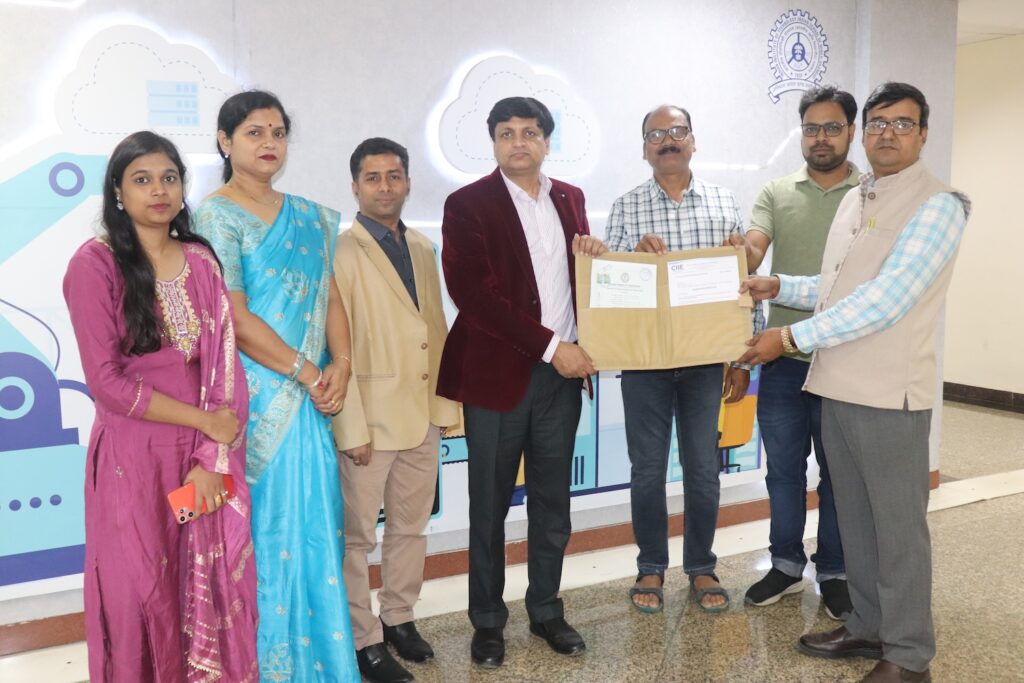
India’s agricultural sector is on the threshold of a technological transformation, where Artificial Intelligence (AI), Robotics, Internet of Things (IoT), and data-driven decision-making are expected to redefine how farming is practiced. Taking a step in this direction, Rajeev Singh, Founder & Director of Sansar Green Mission Pvt. Ltd., recently engaged in a strategic interaction with the leadership of the Centre for Innovation, Incubation & Entrepreneurship (CIIE), IIT (ISM) Dhanbad, along with professors and researchers working in Artificial Intelligence, Robotics, Automation, Electronics, and Smart Systems.
The meeting centered on exploring collaborative opportunities to build intelligent technologies that can solve some of Indian agriculture’s most pressing challenges, particularly in the areas of soil health, precision farming, and digital agriculture.
A New Vision for Indian Agriculture
For decades, farmers have relied on periodic laboratory soil tests and traditional farming practices to make nutrient management decisions. While effective to a certain extent, these methods often fail to provide continuous and location-specific information needed for modern precision agriculture.
During the discussion, Rajeev Singh presented a vision of developing an AI-enabled Soil Intelligence Ecosystem that could deliver real-time insights into soil health, helping farmers make faster, more accurate, and scientifically informed decisions.
The concept aims to integrate advanced digital technologies into agriculture, enabling farmers to monitor changing soil conditions continuously instead of depending solely on seasonal testing.
Bringing Robotics into the Farm
One of the major highlights of the interaction was the application of robotics in agricultural field operations.
The discussions explored the possibility of developing robotic systems capable of automating soil sampling, collecting field data with high precision, and transmitting information to cloud-based analytical platforms. Such systems could significantly reduce manual effort while improving the speed and consistency of soil assessment.
The participants also discussed integrating robotics with GPS, smart sensors, and AI algorithms to support future-ready precision farming practices.
Artificial Intelligence for Better Decisions
Artificial Intelligence is rapidly becoming one of the most transformative technologies in agriculture.
The meeting explored how machine learning models could analyze field-level information and provide recommendations related to nutrient management, crop planning, irrigation scheduling, and soil health improvement.
The long-term objective is to create intelligent systems that continuously learn from agricultural data and improve the accuracy of recommendations over time, helping farmers optimize productivity while reducing unnecessary input costs.
Digital Soil Intelligence
Another important area of discussion was the creation of a live digital soil database capable of storing and updating field information in real time.
Such a platform could combine:
- Smart soil sensors
- Cloud computing
- AI-powered analytics
- GPS-based field mapping
- Mobile advisory applications
- Predictive nutrient management
- Historical soil health records
The platform could enable farmers to access scientific recommendations directly from their mobile devices, allowing them to make timely decisions based on actual field conditions.
Research Meets Entrepreneurship
The interaction reflected the growing importance of partnerships between research institutions and technology-driven startups.
Participants discussed how academic research can be translated into practical innovations through startup-led commercialization, field validation, and scalable product development.
Several areas of future collaboration were explored, including:
- AI applications in agriculture
- Robotics for soil monitoring
- Intelligent sensor development
- Embedded systems for smart farming
- Prototype development
- Technology incubation
- Patent generation
- Commercial deployment of indigenous technologies
Such collaborations are expected to accelerate innovation while ensuring that advanced technologies remain affordable and relevant to Indian farming conditions.
Rajeev Singh on the Future of Agriculture
Speaking after the meeting, Rajeev Singh said:
“The future of farming will be defined by intelligence rather than intuition alone. Artificial Intelligence, Robotics, and digital technologies can empower farmers with real-time knowledge, helping them improve productivity while preserving soil health. Our vision is to build practical technologies that simplify scientific farming and make precision agriculture accessible to every farmer in India. Collaborating with IIT (ISM) Dhanbad provides an opportunity to connect world-class research with real-world agricultural challenges.”
Rimi Singh on Sustainable Innovation
Rimi Singh, Managing Director of Sansar Green Mission Pvt. Ltd., emphasised the importance of responsible technological advancement.
“Innovation should ultimately improve the lives of farmers. We believe AI and Robotics can make agriculture more efficient, sustainable, and environmentally responsible. Our discussions with IIT (ISM) Dhanbad strengthen our commitment to developing technologies that are practical, scalable, and capable of delivering measurable benefits to farming communities.”
Building the Future Together
The discussions concluded with a shared interest in exploring future collaborative research and innovation opportunities in agricultural technology.
As India continues its journey toward Digital Agriculture, collaborations between academic institutions and agritech innovators will play an increasingly important role in developing indigenous technologies for farmers.
The interaction between Rajeev Singh, Sansar Green Mission Pvt. Ltd., and IIT (ISM) Dhanbad reflects a broader vision of combining scientific research with entrepreneurial innovation to create intelligent agricultural solutions. By leveraging AI, Robotics, IoT, and data analytics, such initiatives have the potential to support precision farming, strengthen soil health management, and contribute to a more productive and sustainable agricultural future for India.